Kontakt
 Wie einkaufen
Versand
Kaufberater
 Englisch
 234 b
234 b
30 Tage für die Rückgabe der Ware
Kunden kauften auch

 /
/
 Broschur
 18.79
€
18.79
€

 /
Buch
26.79
€
/
Buch
26.79
€



 /
Broschur
6.99
€
/
Broschur
6.99
€

 /
Broschur
14.99
€
/
Broschur
14.99
€

 /
Broschur
42.49
€
/
Broschur
42.49
€





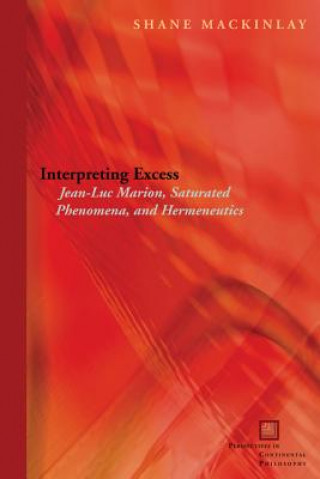
JJean-Luc Marion's theory of saturated phenomena is one of the most exciting developments in phenomenology in recent decades. It opens up new possibilities for understanding phenomena by beginning from rich and complex examples such as revelation and works of art. Rather than being curiosities or exceptions, these excessiveor saturatedphenomena are, in Marion's view, paradigms. He understands more straightforward phenomena, such as the objects of the natural sciences, as reduced and impoverished versions of the excess given in saturated phenomena.Interpreting Excess is a systematic and comprehensive study of Marion's texts on saturated phenomena and their place in his wider phenomenology of givenness, tracing both his theory and his examples across a wide range of texts spanning three decades.The author argues that a rich hermeneutics is implicit in Marion's examples of saturated phenomena but is not set out in his theory. This hermeneutics makes clear that attempts to overthrow the much-criticized sovereignty of the Cartesian ego will remain unsuccessful if they simply reverse the subject-object relation by speaking of phenomena imposing themselves with an overwhelming givenness on a recipient. Instead, phenomena should be understood as appearing in a hermeneutic space already opened by a subject's active reception. Thus, a phenomenon's appearing depends not only on its givenness but also on the way it is interpreted by the receiving subject. All phenomenology is, therefore, necessarily hermeneutic.Interpreting Excess provides an indispensable guide for any study of Marion's saturated phenomena. It is also a significant contribution to ongoing debates about philosophical ways of thinking about God, the relation between hermeneutics and phenomenology, and philosophy after the subject.


Informationen zum Buch
Englisch

Verschenken Sie dieses Buch noch heute
Es ist ganz einfach
1 Legen Sie das Buch in Ihren Warenkorb und wählen Sie den Versand als Geschenk 2 Wir schicken Ihnen umgehend einen Gutschein 3 Das Buch wird an die Adresse des beschenkten Empfängers geliefertDas könnte Sie auch interessieren



 /
/
 Adobe ePub DRM
47.49
€
Adobe ePub DRM
47.49
€