
 Kontakt
 Wie einkaufen
Versand
Kaufberater
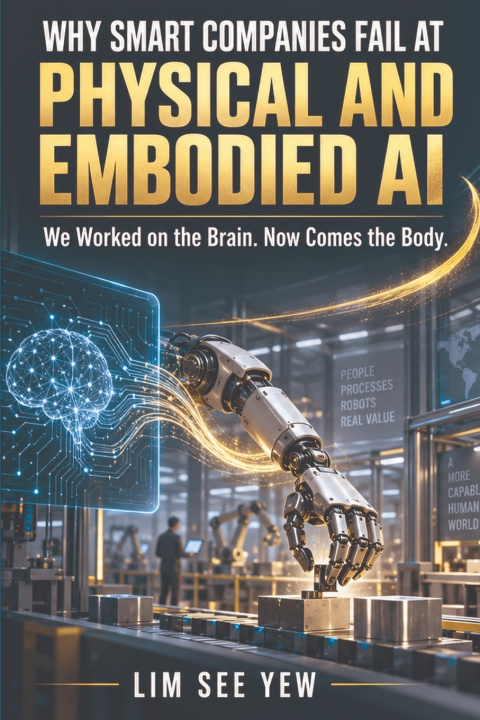
WHY SMART COMPANIES FAIL AT PHYSICAL AND EMBODIED AI
We Worked on the Brain. Now Comes the Body.
 Englisch
 32 b
32 b
 Neu
Neu
Bis zu 30 Tage Rückgaberecht

Artificial intelligence is leaving the screen.
It can now see, navigate, manipulate, inspect, carry and act in the physical world. But as companies rush towards robotics, autonomous systems and embodied AI, many are preparing to repeat the same mistakes they made with cognitive AI.
They will buy the machine before defining the problem. They will confuse automation with transformation, machine autonomy with organisational agency, and released human capacity with business value.
A capable AI system may strengthen operational capability. It does not automatically create a capable organisation.
Why Smart Companies Fail at Physical and Embodied AI is a management playbook for leaders navigating the next, more consequential chapter of artificial intelligence. It is not a robotics engineering manual or another prediction about humanoids replacing everyone. It explains how leaders must redesign work, authority, accountability, workforce capability and customer value when intelligent systems can act directly in the physical world.
Drawing on Phoenix Logic™, Customer Value by Design™ and the new Human Machine Boundary™, the book shows how to:
• Start with the organisational bottleneck-not the robot
• Distinguish machine autonomy from organisational agency
• Decide what machines may execute and what humans must continue to own
• Design override rights, escalation paths and consequence ownership
• Build a complete business case beyond labour replacement
• Redeploy released capacity towards customer and organisational value
• Test deployments with evidence before scaling
• Create a renewable Human-AI operating model as technology evolves
Applications across manufacturing, logistics, healthcare, field work, customer-facing environments and smaller companies show how the principles change in real operating conditions.
The book also includes seven practitioner tools, a worked distribution-centre example, an executive playbook and a one-page Physical AI Decision Record.
The central lesson is simple:
Technology creates operational capability. Human-AI agency converts that capability into organisational and customer value.
The machine can act. The organisation must still decide why, where and to what end.


Informationen zum Buch
Englisch

Verschenken Sie dieses Buch noch heute
Es ist ganz einfach
1 Legen Sie das Buch in Ihren Warenkorb und wählen Sie den Versand als Geschenk 2 Wir schicken Ihnen umgehend einen Gutschein 3 Das Buch wird an die Adresse des beschenkten Empfängers geliefertHallo! Ich bin Libroamiko, dein Buchberater.
Wie kann ich dir helfen?