
 Kontakt
 Wie einkaufen
Versand
Kaufberater
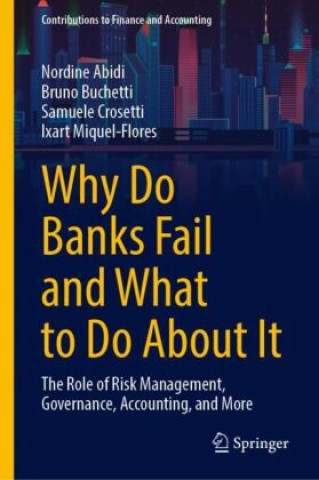
Why Do Banks Fail and What to Do About It
The Role of Risk Management, Governance, Accounting, and More
 Englisch
 309 b
309 b
Bis zu 30 Tage Rückgaberecht
Das könnte Sie auch interessieren










 /
/
 Broschur
 17.69
€
17.69
€

 /
Broschur
52.39
€
/
Broschur
52.39
€

 /
Broschur
19.39
€
/
Broschur
19.39
€












Banking crises are not new. Countries all over the world continue to experience banking failures. These catastrophic events are generally considered of utmost importance because of the essential role banks play in the economy. Banking failures are mainly caused by major risk management deficiencies, creative accounting, inadequate internal control systems, and above all, greedy execu- tive directors. However, questions arise, such as: Why do banks fail? What are the main drivers of these banking failures? Can we avoid a banking crisis? What happens when a bank fails?Chapter one delves into the pivotal roles and functions of banks within the economic ecosystem. It highlights banks as essential intermediaries that facilitate liquidity provision, manage payments, transform assets, and oversee borrowers. Emphasizing their dual function of accepting deposits and granting loans, the chapter underscores the importance of banks in managing and mitigating various types of risks. The narrative further examines the emergent challenges in the banking sector, such as cyber threats, climate change implications, and geopolitical instabilities. Lastly, the chapter underscores the crucial role banks play in the transmission of monetary policy.Banks are susceptible to a range of risks, and chapter two investigates these risks and how they may trigger banking failures. These include liquidity risk (a bank's ability to meet its cash and collateral obligations), credit risk (the risk that a bank borrower will fail to meet its obligations), market risk (a bank's risk of losses in off and on-balance sheet positions arising from adverse movements in market prices), interest rate risk (the risk that a rise in interest rates could force the bank to pay relatively more on its deposits than it receives on its loans), and new risks (e.g., IT risk & environmental risks).Chapter three describes and compares the financial statements of commercial and investment banks, explaining how they differ from those of non-financial companies. Moreover, it delves into the consequences of creative accounting and how these have played a major role in the most recent banking failures. Chapter four outlines how governance issues can trigger banking failures, specifically how directors' insufficient risk monitoring through the board has played a vital role during the recent financial crisis. Finally, chapter five illustrates the functioning of resolution, detailing how resolution authorities have, over time, operationalized the resolvability of banks. This book aims to explain why banks are important in today's economy, how they differ from other companies, the major risks they face in their day-to-day operations, and what happens when they fail (or are at risk of failing). All in all, this book makes a threefold contribution: for researchers, it describes the main drivers of banking failures; for regulators, it offers suggestions on how to improve banks' regulation; and for practitioners, it explains real cases of banking failures and how to manage them.


Informationen zum Buch
Englisch

Verschenken Sie dieses Buch noch heute
Es ist ganz einfach
1 Legen Sie das Buch in Ihren Warenkorb und wählen Sie den Versand als Geschenk 2 Wir schicken Ihnen umgehend einen Gutschein 3 Das Buch wird an die Adresse des beschenkten Empfängers geliefertHallo! Ich bin Libroamiko, dein Buchberater.
Wie kann ich dir helfen?