
 Kontakt
 Wie einkaufen

Versand
Kaufberater
 Englisch
 58 b
 Demnächst
 Neu
Bis zu 30 Tage Rückgaberecht

For thousands of years, we have been reading a book that was never meant to be a single story.
Open any standard translation of the Bible and you will find a text that seems to fight against itself. In one verse, God is an ethereal, cosmic architect who creates the universe with a calm, spoken word. Turn the page, and He is a physical, volatile warrior - marching out of the southern deserts, roaring through volcanic smoke, and demanding the slaughter of rival tribes.
For centuries, theologians have twisted themselves into knots to explain away these contradictions. We are told they are "mysteries of faith," translation errors, or progressive revelations of a single divine mind.
But what if the contradictions aren't mistakes at all? What if they are the scar tissue of a war - a war fought between two gods, across a thousand years, on the same page?
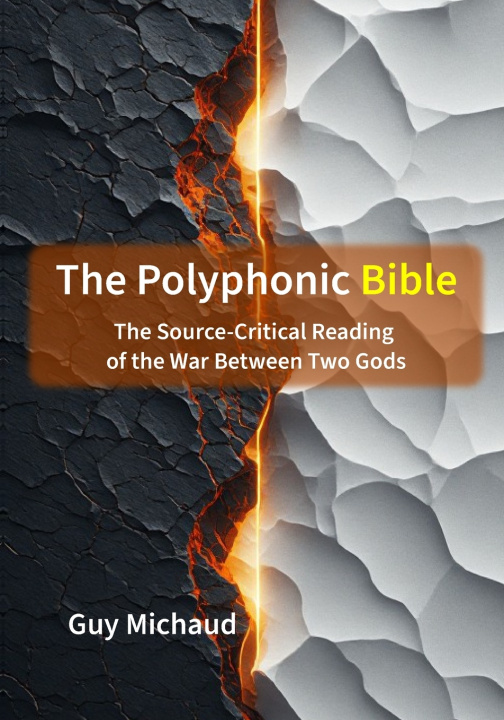
The Polyphonic Bible is a source-critical reading of that war. Its central thesis: the Hebrew Bible is a polyphonic record of a millennium-long theological conflict between El - the wise, seated patriarch, the cosmic administrator, the Bull of Canaan, the god who creates by decree and presides over a divine council of seventy sons - and Yahweh - the storm-and-warrior god of the Midianite wilderness, the jealous, descending, volcanic deity who walks, fights, breathes, and demands blood. Two gods, different in personality, different in geography, different in theology, fused by the Jerusalem scribes into a single nameplate and declared one in the Shema.
The merger was declared. It was never completed.
The book follows the war from its first blood - Cain the farmer bringing the fruit of the soil, Abel the nomad bringing the blood of the flock, and the murder that follows - through its restagings across a millennium: Jacob and Esau, the slaughter at Shechem, the purge at Sinai, the golden calves of Dan and Bethel, the prophets of Baal at Carmel. The same scene, replayed generation after generation. The liturgical loser kills the liturgical winner, or the winner kills the loser. The roles reverse; the structure does not.
Then the book traces the merger itself: the doublet technique that preserved both traditions, the attribute-transfer that absorbed Baal's storm mythology into Yahweh, the Shema's algebraic equation (Yahweh = Elohim), and the fraying seam - the moment in Daniel 7 where the merger breaks open and two divine figures appear in a single vision, the second receiving the worship reserved for God alone.
And finally, the book follows the fraying seam into the New Testament, where Jesus of Nazareth claims the Son-of-Man position of Daniel 7 at his trial, where the high priest recognizes the claim as blasphemy, and where the early church - within decades of the crucifixion - splits the Shema to include Jesus within the divine identity. The merger declared one god. The New Testament worships two.
The first murder was a theological one. So was the last.
The Polyphonic Bible is written for the general reader. It does not require knowledge of Hebrew, Ugaritic, or source criticism. It rests on the established work of mainstream scholars - Frank Moore Cross, Mark S. Smith, John Day, Thomas Römer on the Old Testament side; Martin Hengel, Larry Hurtado, Richard Bauckham on the New Testament side - and synthesizes their work into a clear narrative whose spine runs from Genesis 4 to Revelation 5. A companion volume, The Ancient Matrix (coming soon), explores the speculative material - geodetic measurement, volcanic fallout, the Osarseph tradition - that sits alongside the source-critical reading but belongs in a book honestly framed as speculative.
Welcome to the divine council, hidden in plain sight.


Informationen zum Buch
Englisch

Verschenken Sie dieses Buch noch heute
Es ist ganz einfach
1 Legen Sie das Buch in Ihren Warenkorb und wählen Sie den Versand als Geschenk 2 Wir schicken Ihnen umgehend einen Gutschein 3 Das Buch wird an die Adresse des beschenkten Empfängers geliefertHallo! Ich bin Libroamiko, dein Buchberater.
Wie kann ich dir helfen?