
 Kontakt
 Wie einkaufen
Versand
Kaufberater
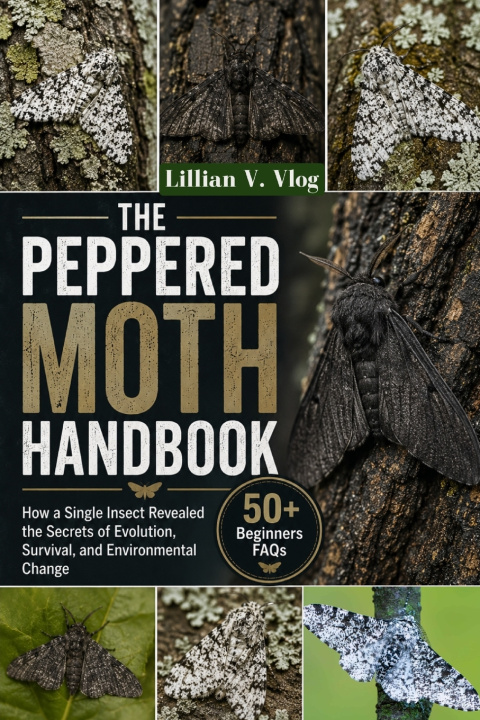
THE PEPPERED MOTH HANDBOOK
How A Single Insect Revealed The Secrets Of Evolution, Survival, And Environmental Change
 Englisch
 55 b
55 b
 Top
Top
 Neu
Neu
Bis zu 30 Tage Rückgaberecht
Kunden kauften auch


 /
/
 Broschur
 15.79
€
15.79
€


























INTRODUCTION TO THE PEPPERED MOTH
The peppered moth is one of the most famous insects in the history of science, not because it is rare, colorful, or unusually beautiful, but because it played a central role in helping scientists understand how evolution works in real time. Its story connects biology, environmental change, and survival in a way that is simple enough to observe and powerful enough to reshape scientific thinking. For more than a century, the peppered moth has been used as a living example of natural selection, showing how species can change in response to their environment.
The scientific name of the peppered moth is Biston betularia. It belongs to a group of moths commonly found in Europe, Asia, and parts of North America. While it may appear ordinary at first glance, its biological history and environmental response make it one of the most studied insects in the world. The moth is especially known for its two main color forms: a light, speckled form and a dark, almost black form. These variations are not separate species but genetic variations within the same species. This difference in coloration is the key feature that brought the peppered moth into scientific importance.
At its core, the peppered moth is a nocturnal insect, meaning it is active at night. During the daytime, it rests on surfaces such as tree bark, where it relies on camouflage to avoid predators. Its wings are shaped in a way that allows it to remain still and blend into its surroundings. The light-colored form typically has white wings with black speckles, resembling the appearance of lichen-covered tree bark. The darker form, sometimes called the "melanic" form, has wings that are mostly black or dark gray, allowing it to blend better with soot-darkened surfaces.
What makes this insect so scientifically important is not just its appearance, but how its population changed dramatically during the Industrial Revolution. Before widespread industrial pollution, the light-colored peppered moth was more common because it blended well with clean, lichen-covered trees. However, as factories began to release large amounts of soot into the environment, tree trunks in industrial regions became darker. In these changed environments, the darker moths had a survival advantage because they were harder for predators to see. Over time, the population shifted, and dark-colored moths became more common in polluted areas. This shift provided clear, observable evidence of natural selection occurring in real time.
To understand why this is significant, it is important to understand what natural selection means. Natural selection is a process where organisms with traits that help them survive and reproduce in their environment are more likely to pass those traits on to future generations. In the case of the peppered moth, the color of the wings determined whether a moth was more or less likely to be eaten by birds. Birds are the main predators of these moths during the day. A moth that blends into its environment has a higher chance of survival, while a moth that stands out is more likely to be eaten before it can reproduce. Over many generations, this difference in survival rates changes the population.
The peppered moth became especially important because it provided one of the clearest real-world examples of evolution driven by environmental change. Before this discovery, many people understood evolution as a theoretical idea based on fossils or long-term observations. However, the peppered moth showed that evolutionary change could happen within a relatively short period of time, and that humans could directly influence it through environmental changes such as pollution.


Informationen zum Buch
Englisch

Verschenken Sie dieses Buch noch heute
Es ist ganz einfach
1 Legen Sie das Buch in Ihren Warenkorb und wählen Sie den Versand als Geschenk 2 Wir schicken Ihnen umgehend einen Gutschein 3 Das Buch wird an die Adresse des beschenkten Empfängers geliefertDas könnte Sie auch interessieren












Hallo! Ich bin Libroamiko, dein Buchberater.
Wie kann ich dir helfen?