
 Kontakt
 Wie einkaufen
Versand
Kaufberater
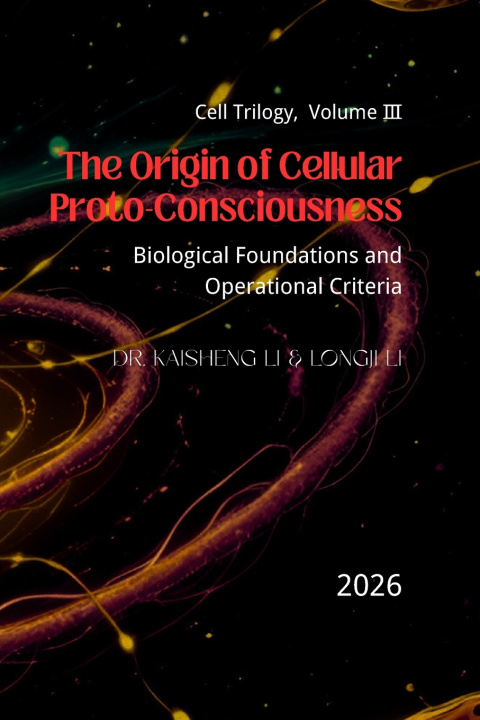
The Origin of Cellular Proto-Consciousness
Biological Foundations and Operational Criteria
 Englisch
 175 b
175 b
Bis zu 30 Tage Rückgaberecht
Kunden kauften auch

 /
/
 Broschur
 29.90
€
29.90
€

The Origin of Cellular Proto-Consciousness reconsiders the origin of consciousness from the level of the living cell. Rather than beginning with the mature nervous system, the book asks a prior question: what biological conditions must exist before consciousness can appear in any higher form? It argues that consciousness should not be treated only as a property of brains, neural networks, or reportable human experience. Before the emergence of neurons and brains, cells had already developed boundaries, internal states, environmental sensing, signal integration, feedback regulation, memory-like persistence, and adaptive state navigation.
The central claim of the book is carefully limited. It does not argue that cells possess human-like consciousness, self-awareness, qualia, or reportable subjective experience. Instead, it proposes that cells may satisfy the minimal functional conditions for proto-consciousness. A cell is not a small brain, but it is not a passive chemical container either. It is a bounded, self-maintaining, historically conditioned system that converts external disturbances into internal states, integrates multiple sources of information, regulates its own processes through feedback, and allows past states to influence present responses.
The book builds its argument through a layered progression: boundary, internal state, information representation, pooling integration, feedback regulation, memory, and proto-consciousness. The cellular membrane provides the first distinction between inside and outside. Internal states such as ion gradients, ATP levels, pH, membrane potential, calcium signaling, metabolic flux, protein conformation, and gene-expression states allow the cell to transform external inputs into usable differences. These differences are then integrated through distributed biochemical and physical networks rather than through symbolic computation. The cell's Perception-Fusion-Regulation loop becomes the minimal architecture through which sensing, integration, and adaptive regulation are connected.
A key contribution of the book is its distinction between functional proto-consciousness and phenomenal consciousness. Functional proto-consciousness refers to the lowest biological conditions under which a living system can sense, integrate, remember, regulate, and navigate states in a history-dependent manner. Phenomenal consciousness, by contrast, involves subjective experience and first-person feeling. The book does not claim to solve the hard problem of consciousness. Instead, it identifies the cellular mechanisms that may constitute the biological preconditions for later conscious systems.
The work also emphasizes falsifiability. The cellular proto-consciousness hypothesis must be testable through measurable variables such as calcium dynamics, ATP levels, pH, ROS, membrane potential, gene-expression changes, epigenetic marks, metabolic states, behavioral trajectories, and perturbation responses. If cellular responses can be fully reduced to independent linear pathways, if no historical dependence can be detected, or if feedback disruption does not affect state navigation, the stronger version of the theory must be weakened or rejected.
By bringing consciousness research back to the cell, the book offers a bridge between origin-of-life theory, cell biology, systems biology, and philosophy of mind. It argues that the emergence of consciousness should be understood not as a sudden event in the brain, but as a layered biological process rooted in the first living systems capable of maintaining an inside, processing information, preserving history, and regulating their own future states.


Informationen zum Buch
Englisch

Verschenken Sie dieses Buch noch heute
Es ist ganz einfach
1 Legen Sie das Buch in Ihren Warenkorb und wählen Sie den Versand als Geschenk 2 Wir schicken Ihnen umgehend einen Gutschein 3 Das Buch wird an die Adresse des beschenkten Empfängers geliefertHallo! Ich bin Libroamiko, dein Buchberater.
Wie kann ich dir helfen?