
 Kontakt
 Wie einkaufen
Versand
Kaufberater
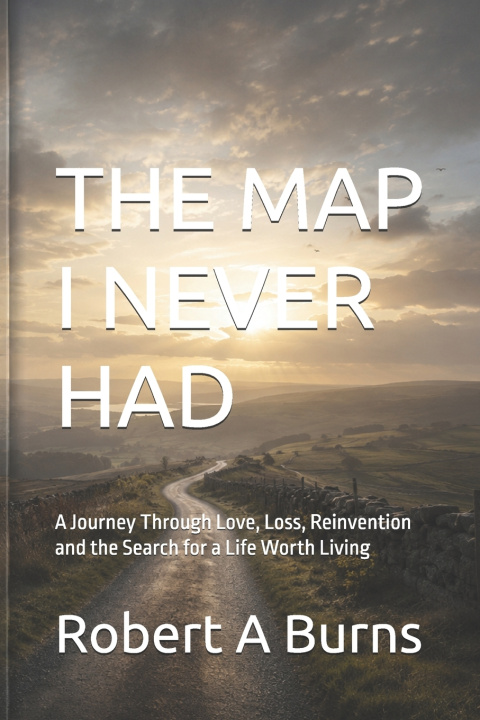
THE MAP I NEVER HAD
A Journey Through Love, Loss, Reinvention and the Search for a Life Worth Living
 Englisch
 37 b
37 b
 Demnächst
 Neu
Neu
Bis zu 30 Tage Rückgaberecht

What happens when the life you thought you would grow old in suddenly disappears?
At sixty-six, after forty years of marriage, Robert A. Burns found himself living alone in a converted barn in the countryside.
The future he had assumed was waiting for him had gone.
For the first time in decades, there was nobody else in the house. No familiar routine to hide behind. No obvious plan for what came next.
And eventually, one uncomfortable question emerged from the silence.
Who am I now?
The Map I Never Had begins with that question, but its answer lies much further back.
Robert returns to the Yorkshire childhood where a naturally curious boy spent his days wondering what lay beyond the next hill. He remembers being uprooted from everything familiar at thirteen, moving south to Wiltshire and, only a year later, experiencing the loss that would bring childhood to an abrupt end when his father died.
From there came work, independence, friendships, love, marriage and children. There were businesses to build, risks to take, responsibilities to carry and the constant pursuit of the next challenge.
For decades, life appeared to be moving forward.
Yet underneath it all ran a thread Robert could not see at the time.
The boy who wanted to understand how things worked became a builder who learned to look beneath the surface. He discovered that cracks have causes, foundations matter and apparently solid structures can carry weaknesses nobody notices until the pressure becomes too great.
Much later, when an unexpected interest in psychology eventually led him into therapy, those lessons took on an entirely different meaning.
People, he discovered, are not so very different.
We carry weight.
We develop cracks.
Our foundations can shift.
And sometimes the strongest-looking lives conceal the greatest strain.
Then, after forty years, Robert's marriage ended.
Once again, the map disappeared.
But this time something was different.
Instead of immediately constructing another life to replace the one he had lost, he began looking backwards.
And slowly, the apparently disconnected chapters began to make sense.
The Map I Never Had is a warm, candid and frequently humorous memoir about childhood, family, fathers and sons, work, ambition, responsibility, marriage, loss, ageing and beginning again.
But beneath those experiences lies a larger question.
How much of life do we really understand while we are living it?
Perhaps the wrong turns were not entirely wrong.
Perhaps some failures were redirections.
Perhaps an ending can create possibilities that could never have existed while the old life remained intact.
And perhaps none of us was ever supposed to have the whole map.
Sometimes the road only makes sense when we finally turn around and see where it has taken us.


Informationen zum Buch
Englisch
