
 Kontakt
 Wie einkaufen
Versand
Kaufberater
 Englisch
 27 b
27 b
 Neu
Neu
Bis zu 30 Tage Rückgaberecht

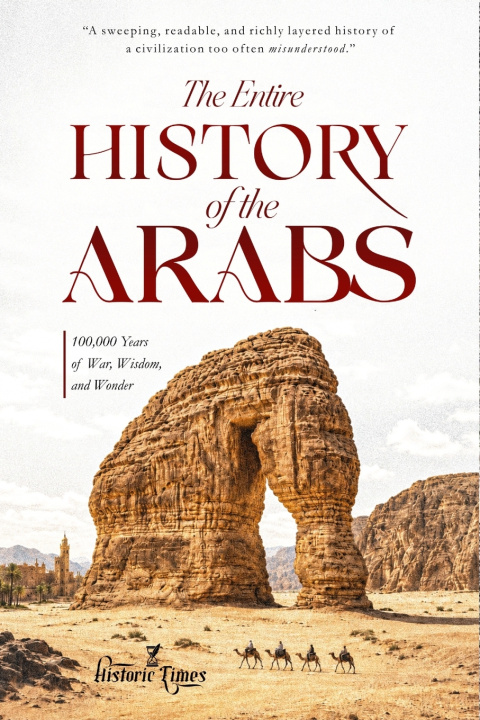
Most people know the Arab world in pieces. A war on the news. An oil price spike. A revolution that leads every broadcast for a month and then disappears. Almost nobody gets the whole picture, and the whole picture is what this book is trying to give.
It starts further back than you'd expect. Long before Islam, before the caravans, before anyone had written a word of scripture, a person walked across the mud of a lake in what is now the Arabian desert and left a footprint that survived for over a hundred thousand years. The land was green then. That single fact undoes most of what people assume about Arabia's past, and the book builds outward from there: the incense kingdoms of ancient Yemen, wealthy enough to trade with Rome on equal footing, the birth of Islam in a cave outside Mecca, and the strange, fast unraveling of two ancient empires at the hands of a newly unified Arabia within a single generation.
Then comes Baghdad. Scholars from half a dozen religions working side by side, translating and expanding everything the ancient world had left behind, giving us algebra, the number system we still use, and the beginnings of real clinical medicine. Two centuries later, Mongol soldiers threw the contents of that same city's libraries into the Tigris until, by some accounts, the river ran black with ink. The book doesn't skip past that. It sits with it, the way it sits with the Ottoman centuries that followed, the discovery of oil under a kingdom that started as a fifty-man raid on a mud fort, and the twentieth century's long run of broken promises, wars, and revolutions that brought the region to where it stands today.
Most histories pick a starting point and let everything before it fade into background noise. Some begin with Muhammad. Some begin with oil. This one doesn't, because skipping ahead is exactly how a region this old keeps getting misread by people looking at it from the outside.
If you want the version of this history that doesn't start halfway through, this is that book.


Informationen zum Buch
Englisch
