
 Kontakt
 Wie einkaufen
Versand
Kaufberater
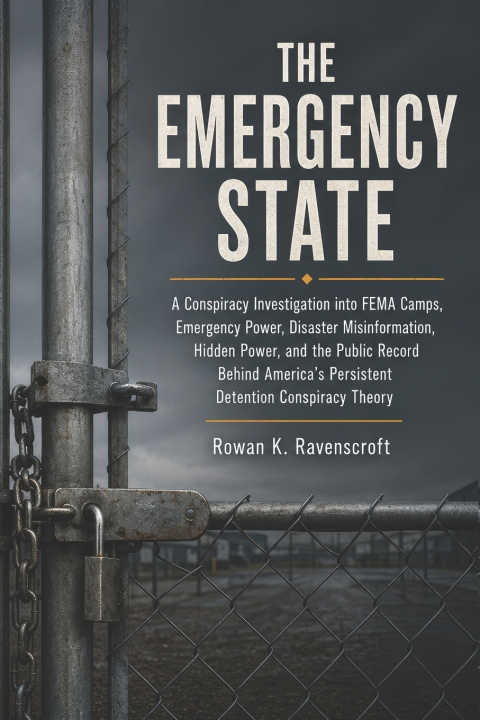
The Emergency State
A Conspiracy Investigation into FEMA Camps, Emergency Power, Disaster Misinformation, Hidden Power, and the Public Record Behind America's Persistent Detention Conspiracy Theory
 Englisch
 47 b
47 b
 Neu
Neu
Bis zu 30 Tage Rückgaberecht

The camps are not proven. The distrust is real.
For decades, the FEMA-camps theory has survived official denials, failed predictions, debunked site lists, and missing bridge evidence. It has moved through anti-federal warnings, militia-era fears, documentary-style media, internet forums, military-exercise panics, hurricane rumors, disaster misinformation, and renewed suspicion whenever crisis weakens public trust.
The Emergency State investigates why.
This is not a book that asks readers to accept every dark claim as fact. It is also not a book that treats public suspicion as stupidity. Instead, Rowan K. Ravenscroft follows the record with discipline: what is documented, what is alleged, what is inferred, what is missing, and what the evidence can-and cannot-carry.
At the center is one disturbing question: why have so many Americans remained ready to believe that emergency government could become a machinery of control?
The answer begins with memory. America has crossed the line into emergency detention before. That history does not prove a modern FEMA detention network, but it explains why terms like relocation, emergency authority, national security, and public safety do not sound neutral to everyone who hears them.
From there, the book examines the agency itself. FEMA was never merely a weather-response office. Its role sits inside a larger emergency architecture involving preparedness, continuity, disaster response, public communication, interagency coordination, and federal authority under pressure. That larger architecture helps explain the agency's place in public imagination-but explanation is not proof.
A serious investigation must hold both truths at once.
The Emergency State traces the theory through REX 84, Garden Plot, H.R. 645, contractor records, ICE and DHS category confusion, Army manuals, continuity planning, Mount Weather, Hurricane Katrina, disaster rumors, Helene, Milton, public trust failure, and the misinformation loop that can turn fear into a safety problem.
The book also studies how claims mutate. A proposed bill becomes an alleged plan. A military manual becomes borrowed fear. A contractor record becomes hidden preparation. A fenced site becomes visual proof. A disaster shelter becomes detention in the public imagination. A denial becomes suspicious simply because it comes from an institution many people no longer trust.
But the investigation does not let suspicion replace evidence.
A secret FEMA political detention system would require more than atmosphere. It would require authorization, funding, site control, staffing, command structure, legal process, detainee categories, transport rules, guard authority, operating procedures, and deployment evidence. Without that chain, the responsible conclusion is narrower than the rumor wants-and less comforting than official messaging may prefer.
The book's Evidence Docket, Chronology Docket A: Verified Baseline, and Chronology Docket B: Narrative Spread are designed to keep documented history, public allegations, disputed claims, credible reporting, and unsupported narratives in their proper evidentiary weight.
This is a book about the rumor-and the country that made the rumor believable.
It does not open onto certainty.
It opens onto a country that no longer knows where emergency ends and control begins.


Informationen zum Buch
Englisch

Verschenken Sie dieses Buch noch heute
Es ist ganz einfach
1 Legen Sie das Buch in Ihren Warenkorb und wählen Sie den Versand als Geschenk 2 Wir schicken Ihnen umgehend einen Gutschein 3 Das Buch wird an die Adresse des beschenkten Empfängers geliefertHallo! Ich bin Libroamiko, dein Buchberater.
Wie kann ich dir helfen?