
 Kontakt
 Wie einkaufen
Versand
Kaufberater
 Englisch
 28 b
28 b
 Demnächst
 Neu
Neu
 Veröffentlichung 20. 08. 2026
Bis zu 30 Tage Rückgaberecht

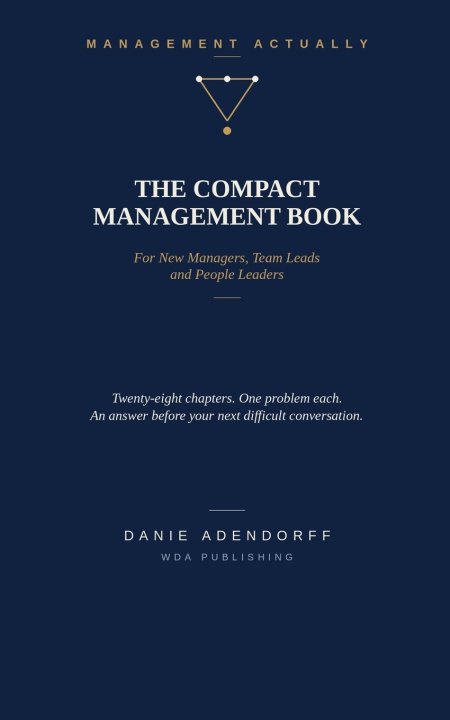
Every year, hundreds of thousands of people are handed a management title and nothing else. No handbook, no course, no handover. The Chartered Management Institute puts the number at eight in ten UK managers who were never trained for the role they now hold. The research is British, but the condition it documents isn't. The same untrained promotion happens in Toronto, Sydney, Auckland, and every other English-language workplace this book will reach. Publishing has answered this gap for decades with two products: the 400-page leadership tome written for people who already run divisions, and the fluffy "guide" that flatters more than it instructs. Neither reaches the person this book is actually for. Picture the newly promoted team lead standing outside a difficult conversation at 4:45pm, with no idea how to start it.
There is a third failure mode, and it's the quieter one: most of what already sits on that shelf was written for a workplace that no longer exists. The management canon in wide circulation today is still built on ideas from the early-to-mid twentieth century: Taylor's scientific management, the org chart as a chain of command, the assumption that authority flows one way and loyalty is owed rather than earned. That model assumed a stable hierarchy, a captive workforce, and a manager whose job was to enforce compliance. None of those assumptions hold in 2026, in any of the markets this book reaches. Teams are hybrid or fully remote. Authority is distributed, not handed down. People ask why before they do what they're told, and a manager who can't answer that question loses the room, not just the argument.
The Compact Management Book was not adapted from a hundred-year-old management canon. It was built from the ground up for the manager operating inside it right now. It is grounded in the argument that command-and-control management has failed the people underneath it, and it translates that argument into twenty-eight short, direct chapters, each addressing one problem a manager actually faces this week, not one a business school assumed they'd face in 1955. It is built to be used, not admired: one problem per chapter, each readable in the time it takes to finish a coffee.
It never speaks in the register of the theory it's grounded in. It speaks in the register of the manager who has a shift to run in twenty minutes, wherever in the world that shift happens to be. That's the real difference this book is built on: not management theory, not management as it was practised in an economy that no longer exists. Management, actually, for the world as it stands in 2026.


Informationen zum Buch
Englisch

Verschenken Sie dieses Buch noch heute
Es ist ganz einfach
1 Legen Sie das Buch in Ihren Warenkorb und wählen Sie den Versand als Geschenk 2 Wir schicken Ihnen umgehend einen Gutschein 3 Das Buch wird an die Adresse des beschenkten Empfängers geliefertHallo! Ich bin Libroamiko, dein Buchberater.
Wie kann ich dir helfen?