
Werden Sie Teil einer Gemeinschaft von Buchliebhabern aus der ganzen Welt und erhalten Sie eine Reihe von Vorteilen.
Konto kostenlos anlegen
Kostenloser Versand mit Zásilkovna ab 69.99 €
Österreichische Post 5.49 €
GLS-Kurier 4.99 €
DPD-Kurier 3.99 €
DPD-Stelle 2.99 €
 Kontakt
 Wie einkaufen
Hilfe
Versand
Österreichische Post 5.49 €
GLS-Kurier 4.99 €
DPD-Kurier 3.99 €
DPD-Stelle 2.99 €
Kostenloser Versand mit Zásilkovna ab 69.99 €
Kaufberater
Mein Konto
▸
Leer :-(
0
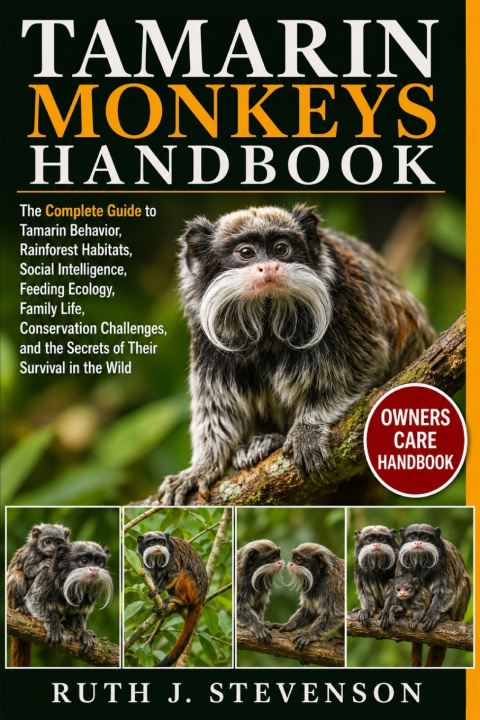
TAMARIN MONKEYS HANDBOOK
The Complete Guide to Tamarin Behavior, Rainforest Habitats, Social Intelligence, Feeding Ecology, Family Life, Conservation Challenges, and the Secrets of Their Survival in the Wild
Sprache
 Englisch
Englisch
Buch
Broschur
Introduction to Tamarin MonkeysHistory and Origins of Tamarin MonkeysTamarin monkeys are among the m...
Vollständige Beschreibung
Libristo-Code: 53017271
?
 57 b
57 b
 Demnächst
 Neu
Neu
57 b
Demnächst
Neu
23.19
€
inkl. MwSt.
Erwartete Einlagerung
Veröffentlichung 29. 06. 2026
Bis zu 30 Tage Rückgaberecht

Introduction to Tamarin Monkeys
History and Origins of Tamarin Monkeys
Tamarin monkeys are among the most fascinating and recognizable members of the New World monkey family. These small primates belong to the family Callitrichidae, which also includes marmosets. Their evolutionary history stretches back millions of years to the tropical forests of Central and South America, where they adapted to life high within the forest canopy. Over countless generations, tamarins developed specialized traits that allowed them to thrive in complex rainforest environments filled with predators, competitors, and ever-changing ecological conditions. Their small size, agility, and cooperative social behavior became key factors in their survival and success.The ancestors of modern tamarins evolved in the rich tropical ecosystems of South America, a region known for its extraordinary biodiversity. As forests expanded and changed over geological time, different tamarin populations became separated by rivers, mountains, and other natural barriers. These isolated populations gradually evolved into distinct species, each adapted to the unique conditions of its environment. This process of diversification resulted in the wide variety of tamarins that exist today, ranging from species with striking facial markings to those with vividly colored coats and distinctive manes.
Throughout history, tamarins have played an important role in the ecosystems they inhabit. By feeding on fruits, insects, nectar, and small prey, they help regulate insect populations and contribute to seed dispersal. Their daily activities support the health and regeneration of tropical forests. Long before scientists began studying them, tamarins were already an integral part of the ecological balance that sustains some of the world's most important rainforest habitats. Indigenous communities living alongside these monkeys often recognized their presence and importance within local ecosystems.
Modern scientific interest in tamarins grew significantly during the twentieth century as researchers sought to understand primate evolution, behavior, and conservation. Their complex social systems, cooperative parenting strategies, and remarkable intelligence attracted the attention of biologists and conservationists around the world. Today, tamarins continue to serve as important subjects in studies of animal behavior, ecology, and conservation, helping people better understand both the natural world and the challenges facing tropical biodiversity.
Different Species of Tamarins
Tamarin monkeys are represented by numerous species, each possessing unique characteristics while sharing many common traits. Although all tamarins belong to the same general group of small New World monkeys, individual species differ in appearance, habitat preferences, geographic distribution, and certain aspects of behavior. These differences have evolved over time as populations adapted to diverse environmental conditions across Central and South America.
One of the most famous species is the Golden Lion Tamarin, known for its brilliant golden-orange fur and mane-like appearance. Native to Brazil's Atlantic Forest, this species has become a symbol of successful conservation efforts after facing severe population declines. Another well-known species is the Emperor Tamarin, distinguished by its long white mustache that gives it a regal appearance. This remarkable facial feature has made the species one of the most recognizable primates in the world.
Schauspielerin
&
Polyglotte
EWA KASP
für
Video abspielen


Libristo bietet die größte Auswahl an fremdsprachiger Literatur an. Deshalb kaufe ich meine Bücher hier ein.
Informationen zum Buch
Vollständiger Name
TAMARIN MONKEYS HANDBOOK
Autor
RUTH J. STEVENSON
Sprache
Englisch
Englisch
Einband
Buch - Broschur
Datum der Veröffentlichung
2026
Anzahl der Seiten
180
EAN
9798184266534
Libristo-Code
53017271
Verlag
Independently published
Gewicht
250
Abmessungen
152 x 229 x 10

Verschenken Sie dieses Buch noch heute
Es ist ganz einfach
1 Legen Sie das Buch in Ihren Warenkorb und wählen Sie den Versand als Geschenk 2 Wir schicken Ihnen umgehend einen Gutschein 3 Das Buch wird an die Adresse des beschenkten Empfängers geliefert
Buchberater Libroamiko
Durch die Nutzung dieses Chats kommunizieren Sie mit generativer künstlicher Intelligenz. Mit der Nutzung erklären Sie sich auch mit der Verarbeitung personenbezogener Daten einverstanden.
Hallo! Ich bin Libroamiko, dein Buchberater.
Wie kann ich dir helfen?
Hallo, ich bin Libroamiko, kann ich helfen?