
 Kontakt
 Wie einkaufen
Versand
Kaufberater
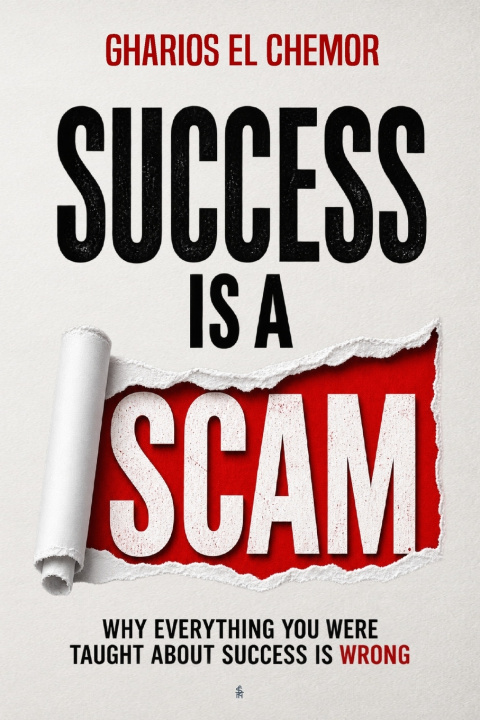
Success Is A Scam
Why Everything You Were Taught About Success Is Wrong
 Englisch
 49 b
49 b
 Neu
Neu
Bis zu 30 Tage Rückgaberecht

WHAT IF EVERYTHING YOU WERE TAUGHT ABOUT SUCCESS IS WRONG?
You were taught the rules early.
Get good grades. Get the degree. Build the career. Make more money. Buy the house. Earn the title. Gain recognition. Keep climbing.
And whatever you do, don't fall behind.
There is only one problem:
Almost nobody stopped to ask whether the scoreboard itself makes any sense.
In SUCCESS IS A SCAM: Why Everything You Were Taught About Success Is Wrong, philosopher Gharios El Chemor challenges one of the deepest assumptions of modern life: that the person who ends up with the most must have succeeded the most.
Consider two people.
One inherits enormous advantages and turns them into an impressive life.
Another begins with poverty, instability, trauma, discrimination, addiction, displacement, or almost no opportunity and manages to build an ordinary one.
Who accomplished more?
Our conventional definition of success cannot answer the question because it measures the destination while ignoring the journey.
It measures altitude instead of ascent.
That mistake affects far more than how we judge other people. It determines how we judge ourselves.
Some people spend their entire lives believing they are failures because they never reached a destination that was extraordinarily difficult from where they began. Others reach everything society promised would make them successful only to discover that the finish line moved again.
More money.
More status.
More recognition.
More.
Drawing from psychology, economics, philosophy, social science, Buddhist thought, and El Chemor's Relative Coherence Theory of Success, SUCCESS IS A SCAM constructs a different way of thinking about achievement.
It asks the questions the conventional scoreboard ignores:
Where did you start?
What were you running against?
What advantages were you given?
How far did you actually travel?
What did you do with what you had?
How much of your potential did you realize?
What did your success cost you?
Who else paid for it?
And was the thing you spent your life pursuing actually worth having?
The result is not another formula for becoming richer, more productive, or more competitive.
It is something more fundamental:
a way to determine whether you are succeeding at your own life.
Through the three tests of Balance, Reason, and Compassion, El Chemor argues that genuine success must survive three questions: Does your life still hold together? Is your understanding of your success actually true? And did your achievement require someone else to pay an unacceptable price?
The answers can produce a startling reversal.
The person society calls a failure may already have achieved something extraordinary.
The person society celebrates as a winner may simply have started near the finish line.
And the person desperately trying to become successful may discover something even more surprising:
Maybe you already won.
For readers of books about success, happiness, meaning, psychology, philosophy, personal development, social inequality, and the hidden forces shaping human behavior, SUCCESS IS A SCAM is not a guide to winning the game.
It asks whether the game was worth winning at all.
This description closely follows the manuscript's treatment of invisible achievement, including recovery, caregiving, first-generation achievement, and rebuilding under severe constraints.


Informationen zum Buch
Englisch
