
 Kontakt
 Wie einkaufen
Versand
Kaufberater
 Englisch
 129 b
129 b
Bis zu 30 Tage Rückgaberecht
Kunden kauften auch

 /
/
 Broschur
 22.99
€
22.99
€


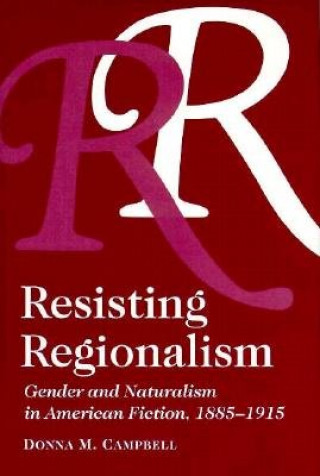
When James Lane Allen defined the "Feminine Principle" and "Masculine Principle" in American fiction for the Atlantic Monthly in 1897, he in effect described local color fiction and naturalism, two branches of realism often regarded as bearing little relationship to each other. In this award-winning study of both movements, Resisting Regionalism explores the effect the cultural dominance of women's local color fiction in the 1890s had on young male naturalist writers, who rebelled against the local colorists and their "teacup tragedies." An immensely popular genre, local color fiction reached its peak in the 1880s in such literary journals as Harper's Monthly, Seribner's, the Atlantic Monthly, and the Century. These short stories exhibited local "characters, " depicted marginal groups and vanishing folkways, and addressed issues of absence, loss, limitation, and the past. Despite such prickly themes, according to Donna Campbell, local color fiction "fulfilled some specific needs of the public - for nostalgia, for a retreat into mildly exotic locales, for a semblance of order preserved in ritual." By the turn of the century, however, local color fiction was fading from the scene, supplanted by writers of adventure fiction and historical romances, with whom local colorists increasingly merged, and opposed by the naturalists. In examining this historic shift, Resisting Regionalism shows that far from being distanced from local color fiction, naturalism emerged in part as a dissenting response to its popularity and to the era's concerns about the dominance of feminine influence in American literature. The new generation of authors, including Crane, Norris, London, Frederic, and Wharton,resisted the cultural myths and narrative strategies common to local colorists Sarah Orne Jewett, Rose Terry Cooke, Mary E. Wilkins Freeman, and Constance Fenimore Woolson. Yet, as Campbell underscores in her analysis of Stephen Crane's The Monster, the naturalists could, and did, in


Informationen zum Buch
Englisch

Verschenken Sie dieses Buch noch heute
Es ist ganz einfach
1 Legen Sie das Buch in Ihren Warenkorb und wählen Sie den Versand als Geschenk 2 Wir schicken Ihnen umgehend einen Gutschein 3 Das Buch wird an die Adresse des beschenkten Empfängers geliefertDas könnte Sie auch interessieren











Hallo! Ich bin Libroamiko, dein Buchberater.
Wie kann ich dir helfen?