
 Kontakt
 Wie einkaufen
Versand
Kaufberater
RADAR METEOROLOGY
Principles, Technologies, and Advanced Interpretation of Severe Weather Radar Signatures
 Englisch
 562 b
562 b
 Neu
Neu
Bis zu 30 Tage Rückgaberecht

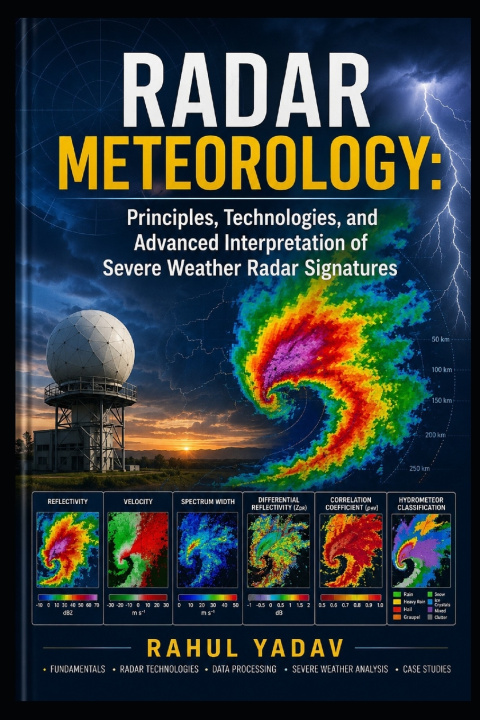
RADAR METEOROLOGY: Principles, Technologies, and Advanced Interpretation of Severe Weather Radar Signatures
Author: Rahul Yadav
Radar Meteorology: Principles, Technologies, and Advanced Interpretation of Severe Weather Radar Signatures is a comprehensive and authoritative guide to the science, technology, and operational applications of weather radar. Designed for meteorologists, atmospheric scientists, researchers, aviation professionals, disaster managers, and students, this book provides an in-depth exploration of how modern radar systems observe, analyse, and forecast weather phenomena across the globe.
Beginning with the historical evolution of radar from military applications to sophisticated meteorological observing systems, the book introduces the fundamental principles of electromagnetic wave propagation, radar equations, reflectivity measurements, Doppler velocity estimation, dual-polarisation technology, and advanced radar instrumentation. Readers are guided through the physical foundations that enable weather radars to detect precipitation, measure wind fields, identify hydrometeor types, and monitor severe weather in real time.
The book offers extensive coverage of operational radar meteorology, including global weather radar networks, scanning strategies, signal processing techniques, data quality control, clutter suppression, and product generation. Special emphasis is placed on the interpretation of radar imagery and the recognition of important radar signatures associated with stratiform precipitation, convective storms, squall lines, mesoscale convective systems, tropical cyclones, monsoon systems, hailstorms, tornadoes, microbursts, and flash floods.
A distinctive feature of this work is its detailed analysis of severe weather radar signatures. Through numerous case studies and image interpretations, readers learn how to identify hook echoes, bow echoes, bright bands, mesocyclones, tornado vortex signatures, bounded weak echo regions, rear inflow notches, cloudburst signatures, and other critical radar features that support forecasting and warning operations.
The book also explores the rapidly evolving future of radar meteorology, including phased-array radar systems, polarimetric advancements, artificial intelligence applications, machine learning-based precipitation estimation, radar data assimilation, and next-generation forecasting technologies.
With extensive illustrations, conceptual diagrams, radar image analyses, mathematical foundations, and real-world case studies from India and around the world, this volume serves as both a practical operational reference and an advanced academic resource. It bridges the gap between radar theory and operational forecasting, empowering readers to interpret radar observations with confidence and apply them effectively to weather analysis, severe storm prediction, hydrological forecasting, aviation meteorology, and disaster risk reduction.


Informationen zum Buch
Englisch
