
 Kontakt
 Wie einkaufen
Versand
Kaufberater
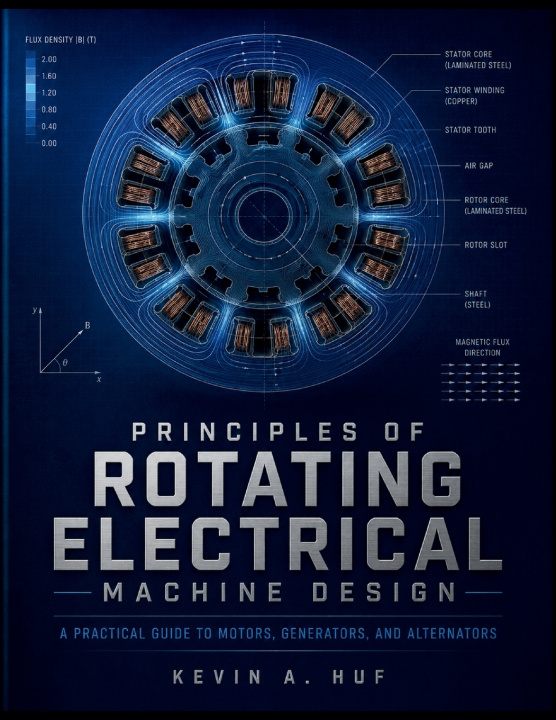
PRINCIPLES OF ROTATING ELECTRICAL MACHINE DESIGN
A Practical Guide to Motors, Generators, and Alternators
 Englisch
 363 b
363 b
 Demnächst
 Neu
Neu
Bis zu 30 Tage Rückgaberecht

Understanding why a rotating magnetic field produces torque is one thing. Turning that principle into a specific rotor diameter, a specific winding layout, and a cooling system that keeps a real machine within its rated temperature rise is another problem entirely - and it is the problem most design references skip.
Engineers and engineering students frequently reach the design stage with strong theoretical grounding in circuit theory and basic electromagnetics, but no clear, connected path from that theory to a finished, manufacturable, testable machine. A winding chosen purely for electromagnetic performance may be difficult to cool; a frame chosen purely for mechanical stiffness may make the winding uneconomical to manufacture. Without a structured, connected design process, engineers can lose time to trial-and-error sizing, miscalculate thermal margins, or discover a mechanical or verification problem only after a prototype has already been built.
This guide provides that structured, connected process. It develops the complete rotating-machine design cycle - first-pass sizing, detailed electromagnetic design, loss and thermal analysis, mechanical integrity checks, systematic optimization, and standards-based verification - as a sequence of numbered engineering decisions, each derived from first principles, illustrated with a fully worked calculation, and shown feeding into and constraining the next.
Benefits
- Translate an application's power, voltage, speed, and duty-cycle requirements into a defensible first estimate of rotor diameter and stack length.
- Size a real slotted stator core and specify a practical winding layout using complete first-principles calculations.
- Select an insulation system and thermal class appropriate to a machine's duty and operating environment.
- Follow dedicated, first-principles design procedures for induction, synchronous, direct-current, and permanent-magnet machines.
- Build a complete loss budget and size a cooling system that keeps a machine within its rated temperature rise.
- Check a finished design against shaft stress, critical speed, bearing life, and vibration limits, and apply systematic optimization to trade design variables against cost, mass, and efficiency.
- Follow four complete, worked design case studies - an industrial pump motor, an electric-vehicle traction motor, a wind-turbine generator, and a standby generator set - that apply every method in the book to real application scenarios.
Electromagnetic fundamentals and magnetic-circuit analysis; slotted stator core, winding, and insulation design; induction, synchronous, direct-current, and permanent-magnet machine design; loss and efficiency calculation; thermal design and cooling-system sizing; mechanical design and rotor dynamics; systematic design optimization; standards-based testing and verification; modern and emerging design topics; manufacturing and economic design trade-offs; generator design and grid interconnection; and four fully worked design case studies.
This guide is written for practicing electrical and mechanical engineers who design, specify, or evaluate motors, generators, or alternators; engineers transitioning from analysis, maintenance, or manufacturing roles into machine design; and engineering students and early-career engineers who have completed foundational coursework in circuit theory and electromagnetics and want a single, connected reference from first sizing calculation to a mechanically sound, standards-verified machine.
Get your copy and discover a structured, connected approach to the questions, challenges, and opportunities explored throughout the book - from a first sizing estimate to a design ready for verification testing.


Informationen zum Buch
Englisch

Verschenken Sie dieses Buch noch heute
Es ist ganz einfach
1 Legen Sie das Buch in Ihren Warenkorb und wählen Sie den Versand als Geschenk 2 Wir schicken Ihnen umgehend einen Gutschein 3 Das Buch wird an die Adresse des beschenkten Empfängers geliefertHallo! Ich bin Libroamiko, dein Buchberater.
Wie kann ich dir helfen?