
 Kontakt
 Wie einkaufen

Versand
Kaufberater
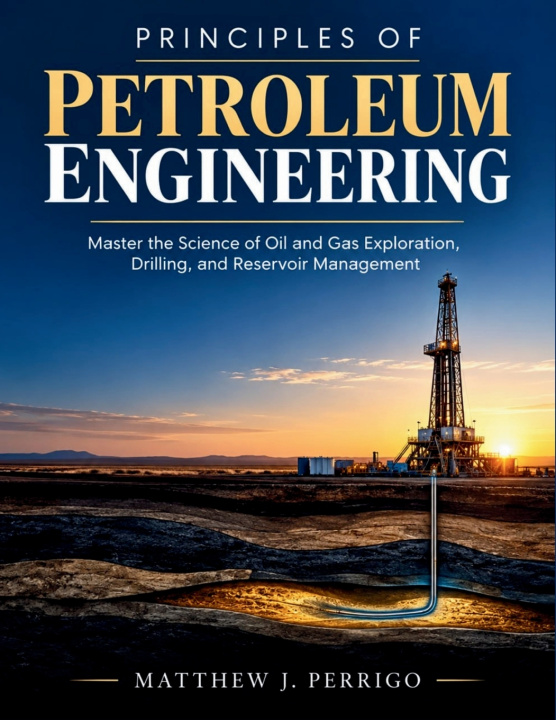
Principles of Petroleum Engineering
Master the Science of Oil and Gas Exploration, Drilling, and Reservoir Management
 Englisch
 141 b
 Neu
Bis zu 30 Tage Rückgaberecht

Every decision in petroleum engineering carries weight. Whether a well flows safely, how much of a reservoir's oil and gas is recovered, and whether a development earns its investment all depend on engineers who can reason quantitatively about fluids moving through rock far below the surface.
Yet the subject is often learned in fragments: reservoir behavior in one course, drilling in another, production in a third, economics at the end. Equations arrive without the reasoning that connects them, correlations are used without their limits, and units are left to chance. The result is knowledge that can be recited but not confidently applied.
Principles of Petroleum Engineering closes that gap. Its fourteen chapters follow the life cycle of a hydrocarbon reservoir, from the way oil and gas form and accumulate, through formation evaluation, drilling, completion and production, to recovery, reserves and project economics. Every chapter builds from first principles, names its assumptions and carries units through each calculation.
Inside, you will:
- Understand rock and fluid behavior: porosity, permeability, capillary pressure, wettability, phase behavior and the fluid property correlations used in everyday reservoir calculations.
- Read the subsurface: interpret the standard open-hole log suite, estimate water saturation and net pay, and integrate log and core data.
- Plan and complete wells: wellbore pressures, the pore-pressure and fracture-gradient window, casing, drilling fluids, directional drilling, well control, cementing, perforating and sand control.
- Analyze production: locate a well's operating point with inflow and outflow performance methods, diagnose common problems and compare the main artificial lift systems.
- Interpret reservoir performance: read drawdown and buildup tests with semi-log and derivative plots, and estimate reserves with volumetric, material balance and decline curve methods.
- Evaluate recovery and value: assess waterflooding, thermal, miscible and chemical recovery, shale and heavy oil development, and weigh projects with discounted cash flow and decision analysis.
More than 50 worked examples show complete solutions with units at every step, so they double as templates for your own calculations. Each chapter opens with learning objectives and closes with key equations and practice problems, supported by selected answers, more than 130 figures, a glossary, nomenclature, unit conversions and fluid property correlations.
This book is written for upper-level undergraduate and graduate petroleum engineering students, engineers moving into upstream oil and gas from mechanical, chemical, civil or environmental backgrounds, and early-career reservoir, production and drilling engineers who want a rigorous, compact reference. Readers should be comfortable with university-level calculus, physics and chemistry.
Get your copy and start building the connected, quantitative understanding of reservoirs, wells and production that sound engineering decisions depend on.


Informationen zum Buch
Englisch

Verschenken Sie dieses Buch noch heute
Es ist ganz einfach
1 Legen Sie das Buch in Ihren Warenkorb und wählen Sie den Versand als Geschenk 2 Wir schicken Ihnen umgehend einen Gutschein 3 Das Buch wird an die Adresse des beschenkten Empfängers geliefertHallo! Ich bin Libroamiko, dein Buchberater.
Wie kann ich dir helfen?