
 Kontakt
 Wie einkaufen
Versand
Kaufberater
 Englisch
 59 b
59 b
 Demnächst
 Neu
Neu
Bis zu 30 Tage Rückgaberecht

There is a point past which growth destroys more than it creates. We passed it decades ago.
On the tenth of January, 2026, the richest one percent of humanity finished spending their share of the year's carbon.
Seven of the nine planetary boundaries that keep the Earth habitable have now been crossed. Twelve people hold more wealth than the poorest half of the human race. One in four people faces food insecurity. And by the single number that governs economic policy in every country on Earth, the world economy is performing well.
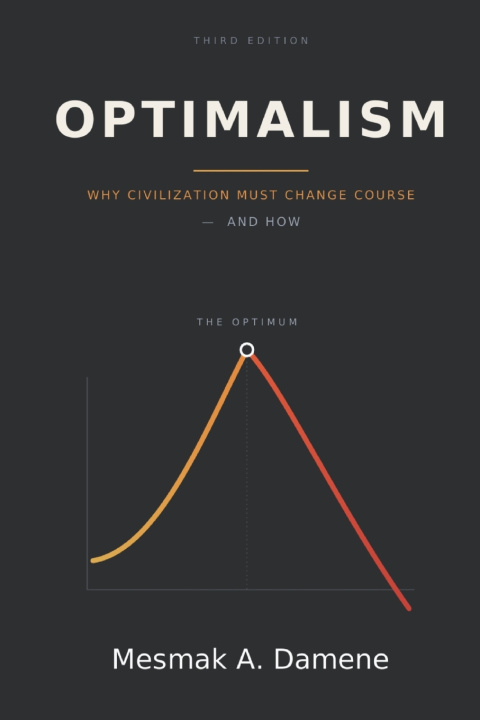
OPTIMALISM argues that this is not the system failing. It is the system working exactly as designed - because growth was chosen as the objective of economic policy in the middle of the twentieth century, using a measure built for a different purpose, at a moment when the planet still looked infinite.
The alternative is not poverty and it is not contraction. It is an optimum: the level of output, in each place, that delivers the most human well-being that can be sustained. In much of the world that optimum lies above current production - a billion people still lack reliable electricity, and building it for them violates no ecological limit. In the wealthy world it lies below.
But locating the optimum solves nothing on its own. Nobody who profits from exceeding it will ever choose to stop. That is not a moral failing. It is a structural one - and it is a question about who owns the assets, and therefore who gets to decide.
This third edition is a demand. Seven of them.
Substantially rewritten and restructured, it covers:
- Why GDP records the destruction of a forest as income and its survival as nothing
- How natural resources come to be systematically underpriced - and what it would take to fix it
- The case for economic democracy, grounded in institutions that already work: Mondragón, German co-determination, Norway's sovereign wealth fund, Danish community wind, Preston's community wealth building
- Money creation, sovereign debt, and the extraction that continues from poor countries to rich ones
- A new chapter on artificial intelligence - not job losses, but what happens when capital's share of output rises in an economy where capital ownership has never been more concentrated
- An entire chapter given to the strongest objections against the book's own argument, from six schools of economic thought - two of which the author concedes he cannot fully answer
Written for the general reader. The mathematics is real, and it is in an appendix, where it can be checked or skipped without losing the thread.
"Systems under this much strain do change. They change by design or they change by collapse. The difference is not whether the change arrives. It is how many people are alive at the end of it."
For readers of Doughnut Economics, Less Is More, Prosperity Without Growth, and The Value of Everything.


Informationen zum Buch
Englisch
