
 Kontakt
 Wie einkaufen
Versand
Kaufberater
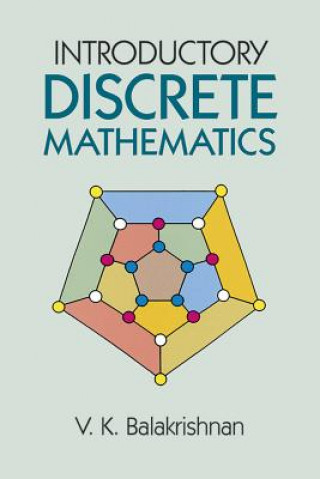
Introductory Discrete Mathematics
 Englisch
 41 b
41 b
Bis zu 30 Tage Rückgaberecht
Kunden kauften auch




Preface 0 Set Theory and Logic 0.1 Introduction to Set Theory 0.2 Functions and Relations 0.3 Inductive Proofs and Recursive Definitions 0.4 The Language of Logic 0.5 Notes and References 0.6 Exercises 1 Combinatorics 1.1 Two Basic Counting Rules 1.2 Permutations 1.3 Combinations 1.4 More on Permutations and Combinations 1.5 The Pigeonhole Principle 1.6 The Inclusion-Exclusion Principle 1.7 Summary of Results in Combinatorics 1.8 Notes and References 1.9 Exercises 2 Generating Functions 2.1 Introduction 2.2 Ordinary Generating Functions 2.3 Exponential Generating Functions 2.4 Notes and References 2.5 Exercises 3 Recurrence Relations 3.1 Introduction 3.2 Homogeneous Recurrence Relations 3.3 Inhomogeneous Recurrence Relations 3.4 Recurrence Relations and Generating Functions 3.5 Analysis of Alogorithms 3.6 Notes and References 3.7 Exercises 4 Graphs and Digraphs 4.1 Introduction 4.2 Adjacency Matrices and Incidence Matrices 4.3 Joining in Graphs 4.4 Reaching in Digraphs 4.5 Testing Connectedness 4.6 Strong Orientation of Graphs 4.7 Notes and References 4.8 Exercises 5 More on Graphs and Digraphs 5.1 Eulerian Paths and Eulerian Circuits 5.2 Coding and de Bruijn Digraphs 5.3 Hamiltonian Paths and Hamiltonian Cycles 5.4 Applications of Hamiltonian Cycles 5.5 Vertex Coloring and Planarity of Graphs 5.6 Notes and References 5.7 Exercises 6 Trees and Their Applications 6.1 Definitions and Properties 6.2 Spanning Trees 6.3 Binary Trees 6.4 Notes and References 6.5 Exercises 7 Spanning Tree Problems 7.1 More on Spanning Trees 7.2 Kruskal's Greedy Algorithm 7.3 Prim's Greedy Algorithm 7.4 Comparison of the Two Algorithms 7.5 Notes and References 7.6 Exercises 8 Shortest Path Problems 8.1 Introduction 8.2 Dijkstra's Algorithm 8.3 Floyd-Warshall Algorithm 8.4 Comparison of the Two Algorithms 8.5 Notes and References 8.6 Exercises Appendix What is NP-Completeness? A.1 Problems and Their Instances A.2 The Size of an Instance A.3 Algorithm to Solve a Problem A.4 Complexity of an Algorithm A.5 "The "Big Oh" or the O(·) Notation" A.6 Easy Problems and Difficult Problems A.7 The Class P and the Class NP A.8 Polynomial Transformations and NP-Completeness A.9 Coping with Hard Problems Bibliography Answers to Selected Exercises Index


Informationen zum Buch
Englisch
Kategorie

Verschenken Sie dieses Buch noch heute
Es ist ganz einfach
1 Legen Sie das Buch in Ihren Warenkorb und wählen Sie den Versand als Geschenk 2 Wir schicken Ihnen umgehend einen Gutschein 3 Das Buch wird an die Adresse des beschenkten Empfängers geliefertDas könnte Sie auch interessieren
 /
/
 Broschur
 16.79
€
16.79
€
 /
Broschur
108.39
€
/
Broschur
108.39
€

 /
Broschur
28.19
€
/
Broschur
28.19
€



 /
Broschur
21.09
€
/
Broschur
21.09
€


 /
Broschur
51.29
€
/
Broschur
51.29
€


 /
Broschur
21.09
€
/
Broschur
21.09
€
 /
Broschur
24.29
€
/
Broschur
24.29
€
Hallo! Ich bin Libroamiko, dein Buchberater.
Wie kann ich dir helfen?