
 Kontakt
 Wie einkaufen
Versand
Kaufberater
 Englisch
 43 b
43 b
 Demnächst
 Neu
Neu
Bis zu 30 Tage Rückgaberecht

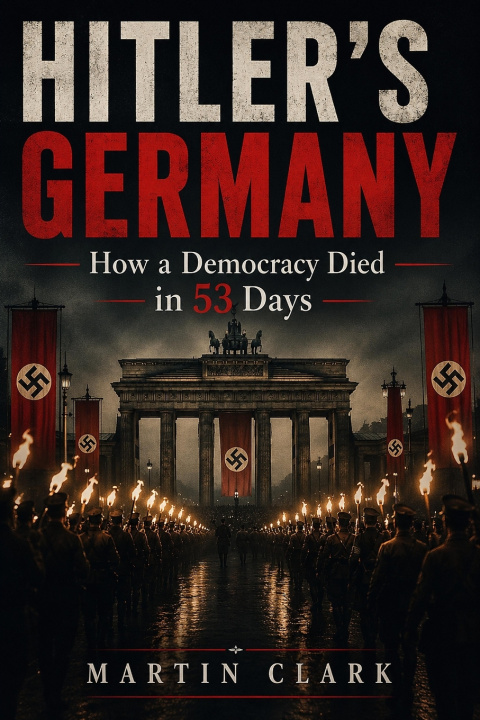
On 30 January 1933, Adolf Hitler was appointed Chancellor of Germany by a lawful act of the elected President. His party held three seats in a cabinet of eleven. The constitution guaranteed a free press, free assembly and personal liberty. The conservatives who arranged the appointment kept the army, the foreign ministry and the treasury, and one of them told a doubter that within two months they would have Hitler so far into a corner he would squeak.
Fifty-three days later the parliament voted to abolish itself, and not one law had been broken to get there.
There was no coup. No building was stormed. No garrison mutinied. Every step had a document behind it, a signature on the document, and the correct countersignature beneath.
This is the day-by-day account of how it was done. The emergency decree that suspended eight fundamental liberties, drafted, agreed and signed within eighteen hours of the Reichstag fire, using an article of the constitution that three previous chancellors had already worn smooth. The administrative order that turned fifty thousand stormtroopers into police officers, issued on an ordinary Wednesday and reported in the papers as a public safety measure. An election held six days after civil liberties were suspended, with the opposition leadership already in cells, which the party still failed to win, taking 43.9 per cent. Seventeen state governments removed one at a time, each facing the choice alone. A parliament that amended its own quorum rules so that it could hand away its power by 441 votes to 94. And, sixteen months later, a statute of a single sentence that declared roughly a hundred murders lawful, four days after they were committed.
Martin Clark works from the statutes, the cabinet minutes, the election returns and the trial transcripts, and states plainly where the evidence is firm, where it is thin, and where historians still disagree. The origin of the Reichstag fire is not settled, and it is not presented here as though it were.
The result is a history without monsters, which is what makes it difficult to put down. Reasonable men made defensible calculations. Institutions consulted their own interests. Judges applied the law correctly to statutes that had stopped meaning anything. Professional associations, sports clubs and choral societies coordinated themselves in properly minuted meetings, by majority vote, with the treasurer's report accepted. Nobody in a position to stop it ever saw a morning that looked like the morning to act. They were right about each individual step and catastrophically wrong about the sum.
If you have ever wondered how a country with the finest legal tradition in Europe, the best universities in the world and eight written guarantees of liberty could be taken apart in eight weeks by men filling in forms, this book shows you, morning by morning, exactly how.
Four parts. Thirty-eight chapters. The fifty-three days, what led to them, and what they had built by the summer of 1934.


Informationen zum Buch
Englisch

Verschenken Sie dieses Buch noch heute
Es ist ganz einfach
1 Legen Sie das Buch in Ihren Warenkorb und wählen Sie den Versand als Geschenk 2 Wir schicken Ihnen umgehend einen Gutschein 3 Das Buch wird an die Adresse des beschenkten Empfängers geliefertHallo! Ich bin Libroamiko, dein Buchberater.
Wie kann ich dir helfen?