
 Kontakt
 Wie einkaufen
Versand
Kaufberater
 Englisch
 74 b
74 b
 Neu
Neu
Bis zu 30 Tage Rückgaberecht

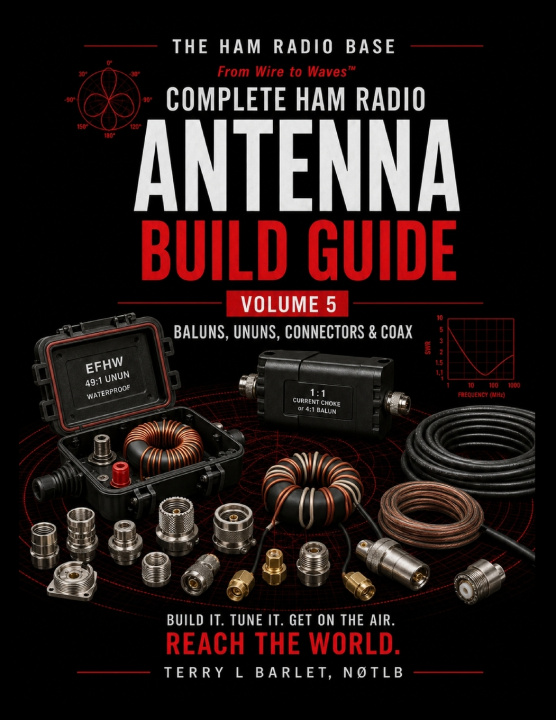
The Complete Ham Radio Antenna Build Guide - Volume 5: Baluns, Ununs, Connectors & Coax
Every antenna in the first four volumes of this series depends on something this final volume covers in depth: getting RF energy cleanly from your radio to the antenna, and keeping it there instead of leaking onto your feedline, your tower, or the outside of your coax shield. Volume 5 is the volume that ties the whole series together - the feed systems, matching devices, and hardware that make every antenna you've built actually perform the way it's supposed to.
The book opens with common-mode current and the chokes built to control it. You'll learn what common-mode current actually is, why it shows up on the outside of your coax shield regardless of how well-matched your antenna is, and how it causes real problems - pattern distortion, RF-in-the-shack symptoms, and noise pickup on receive. Current choke construction is covered in real detail: core selection, turns counts, and the difference between an air-core choke and a ferrite-wound one, with guidance on when each approach is the right call.
From there, the volume moves into 1:1 and 4:1 baluns - the workhorses of dipole and Yagi feed systems. You'll learn the real difference between a voltage balun and a current balun, why a current balun is almost always the better choice despite the extra winding complexity, and how to wind one correctly on the right core material for your power level and frequency range. The 4:1 balun gets its own dedicated construction section, covering the transmission-line transformer winding technique and the applications - folded dipoles, some Yagi driven elements, and certain multiband antennas.
Ununs get the same depth of treatment. The 9:1 unun, essential for random wire and end-fed antennas with a counterpoise, is covered from winding technique through practical installation. The 49:1 unun - the transformer that makes end-fed half-wave antennas work, referenced throughout earlier volumes whenever an EFHW build came up - gets a complete, standalone build-out here: core selection, the specific winding ratio that gets you to 49:1, and the construction details that separate a transformer that actually works from one that just looks right.
Feedlines and connectors round out the volume with the kind of practical detail most antenna books skip entirely. Coaxial cable types are compared honestly - loss characteristics, power handling, and when the extra cost of low-loss cable is actually worth it versus when standard RG-8X is perfectly adequate. PL-259 and SO-239 connector installation is covered step by step, including the soldering technique that separates a connector that survives years of weather from one that fails in six months. Weatherproofing gets dedicated attention too - the specific materials and layering technique (self-amalgamating tape over electrical tape, or the reverse, and why the order matters) that actually keeps water out of a connection exposed to years of sun, rain, and freeze-thaw cycles.
The volume closes with testing - how to verify a balun or unun is actually performing correctly rather than just assuming it works because the antenna transmits, using a NanoVNA or antenna analyzer to check for unexpected loss or a ratio that's drifted from spec.
Every section in this volume follows the same construction-first approach as the rest of the series: clear theory, complete materials lists, step-by-step winding and assembly instructions, and verification procedures to confirm your build performs correctly. Interactive online calculators at hamradiobase.com/ham-radio-antenna-build-guides complement every chapter, helping you work out turns counts and core selections for your specific power level and frequency range.


Informationen zum Buch
Englisch

Verschenken Sie dieses Buch noch heute
Es ist ganz einfach
1 Legen Sie das Buch in Ihren Warenkorb und wählen Sie den Versand als Geschenk 2 Wir schicken Ihnen umgehend einen Gutschein 3 Das Buch wird an die Adresse des beschenkten Empfängers geliefertHallo! Ich bin Libroamiko, dein Buchberater.
Wie kann ich dir helfen?