
 Kontakt
 Wie einkaufen
Versand
Kaufberater
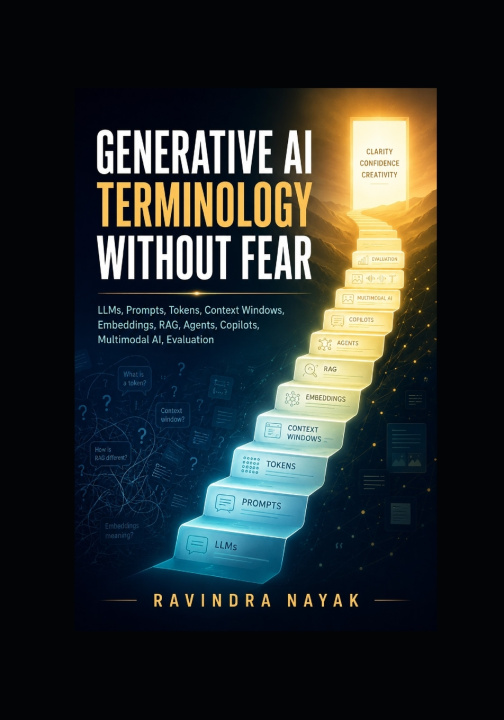
Generative AI Terminology Without Fear
 Englisch
 47 b
47 b
 Neu
Neu
Bis zu 30 Tage Rückgaberecht

Technical conversations about generative AI can feel as though they begin halfway through the story.
Someone mentions an LLM, token, context window, embedding, RAG pipeline, agent, copilot, or multimodal model-and everyone seems expected to understand immediately. A quick definition rarely solves the problem. One unfamiliar term leads to several more, and the subject begins to feel more distant rather than clearer.
Generative AI Terminology Without Fear was written to close that distance.
This beginner-friendly guide explains the language of generative AI from first principles. It does not treat terminology as a collection of dictionary entries. It reveals the purpose beneath each term: what problem created it, what it means in practice, how it connects with other ideas, where it is useful, and what can still go wrong.
Through clear explanations, grounded analogies, practical situations, thoughtful dialogues, visual learning maps, reflection exercises, and a value-packed thinking laboratory, readers gradually build a complete mental model of modern generative AI.
Inside the book, you will learn how large language models generate responses, why text is divided into tokens, what context windows can and cannot hold, how prompting works, how embeddings represent relationships, why semantic search differs from keyword search, how retrieval-augmented generation grounds an answer in external information, how agents use tools and workflows, what copilots and multimodal systems actually do, and how AI outputs should be evaluated before they are trusted.
The book also addresses the questions that matter beyond vocabulary. Why can a fluent answer still be wrong? When should a source be checked? What is the difference between a model, a system, and a product? When should AI assist a person rather than act independently? How can a complicated problem be divided into manageable parts? What does responsible human judgment look like when AI becomes part of everyday work?
No programming background is required. No advanced mathematics is assumed. The explanations begin with ordinary human questions and build technical understanding one reliable layer at a time.
This book is for students, self-learners, career switchers, founders, managers, professionals working with technical teams, and curious readers who want to understand generative AI without pretending to be experts.
You will not finish with a pile of memorized definitions. You will finish with a practical language for asking better questions, evaluating claims, explaining ideas clearly, and using generative AI with greater confidence and care.
The future becomes less intimidating when its language finally makes sense.


Informationen zum Buch
Englisch

Verschenken Sie dieses Buch noch heute
Es ist ganz einfach
1 Legen Sie das Buch in Ihren Warenkorb und wählen Sie den Versand als Geschenk 2 Wir schicken Ihnen umgehend einen Gutschein 3 Das Buch wird an die Adresse des beschenkten Empfängers geliefertHallo! Ich bin Libroamiko, dein Buchberater.
Wie kann ich dir helfen?