
 Kontakt
 Wie einkaufen
Versand
Kaufberater
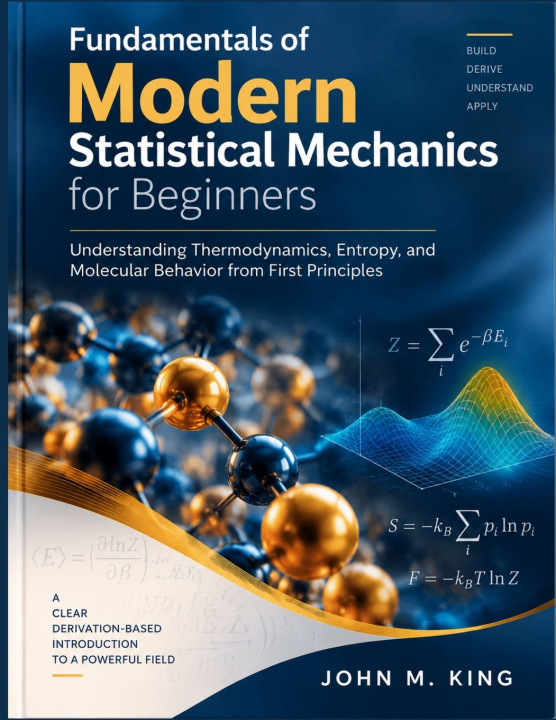
Fundamentals of Modern Statistical Mechanics for Beginners
Understanding Thermodynamics, Entropy, and Molecular Behavior from First Principles
 Englisch
 193 b
193 b
 Neu
Neu
Bis zu 30 Tage Rückgaberecht

A single cylinder of ordinary gas holds an incomprehensibly large number of molecules, each one following its own unpredictable path - and yet a thermometer and a pressure gauge on that same cylinder report two steady, reproducible numbers every time. Explaining how that happens, honestly and step by step from first principles, is the task this book sets for itself, and the task it completes across fourteen chapters that read as a single continuous argument rather than a collection of loosely related topics.
Most readers meet statistical mechanics as a wall of postulates and equations to be accepted on faith: entropy always increases, the Boltzmann distribution looks like this, the Bose-Einstein and Fermi-Dirac distributions look like that. When a formula appears without its derivation, there is nothing to reason from once a slightly different problem is posed, and no way to see why the subject fits together as one framework rather than disconnected results to memorize separately for gases, magnets, photons, and metals.
This book closes that gap. Starting from a single assumption about probability, it derives everything else that follows - temperature, entropy, the ideal gas law, quantum statistics, phase transitions, and fluctuations - as consequences of counting, with every equation built from stated assumptions rather than presented as something to memorize. Notation is introduced once and never repurposed, so a symbol's meaning from an earlier chapter can always be trusted in a later one.
Working through this book helps you:
● Understand why temperature, pressure, and entropy exist as dependable macroscopic quantities even though the microscopic behavior underneath them is unpredictable.
● Derive the Boltzmann distribution and the partition function from a reservoir argument, then use that single object to obtain every thermodynamic quantity by differentiation alone.
● See exactly where the Bose-Einstein and Fermi-Dirac distributions come from, rather than treating them as separate rules for photons, electrons, and other quantum particles.
● Work a phase transition through a concrete interacting-spin model, distinguishing first-order from continuous transitions and seeing where a critical exponent actually comes from.
● Follow real gases and fluctuation theory from the same partition-function machinery used throughout, so later chapters reinforce rather than replace earlier ones.
● Work dozens of fully solved practice problems in every chapter, each with its complete answer included, so gaps in understanding surface immediately rather than at the end of the book.
Key topics covered: probability and combinatorics; microstates, macrostates, and the statistical definition of entropy; the microcanonical, canonical, and grand canonical ensembles; the partition function and its thermodynamic derivatives; the classical ideal gas and the Maxwell-Boltzmann distribution; quantum statistics for bosons and fermions, including blackbody radiation and the electron gas in metals; phase transitions, critical phenomena, and universality; real gases; fluctuations and response functions; and a closing chapter surveying nonequilibrium statistical mechanics, the entropy-information connection, and extensions to complex, many-body systems beyond physics.
Who this book is for: readers meeting statistical mechanics for the first time who already have a first course in calculus, a working familiarity with classical mechanics, and an introductory treatment of thermodynamics - typically upper-level physics, engineering, or chemistry students, and self-learners who want a single, structured reference to return to chapter by chapter.
Open the book and begin developing the knowledge needed to approach statistical mechanics with clarity and confidence, one derivation at a time.


Informationen zum Buch
Englisch

Verschenken Sie dieses Buch noch heute
Es ist ganz einfach
1 Legen Sie das Buch in Ihren Warenkorb und wählen Sie den Versand als Geschenk 2 Wir schicken Ihnen umgehend einen Gutschein 3 Das Buch wird an die Adresse des beschenkten Empfängers geliefertHallo! Ich bin Libroamiko, dein Buchberater.
Wie kann ich dir helfen?