
 Kontakt
 Wie einkaufen
Versand
Kaufberater
Columbia
 Englisch
 24 b
24 b
 Demnächst
 Neu
Neu
 Termin unbekannt
Bis zu 30 Tage Rückgaberecht

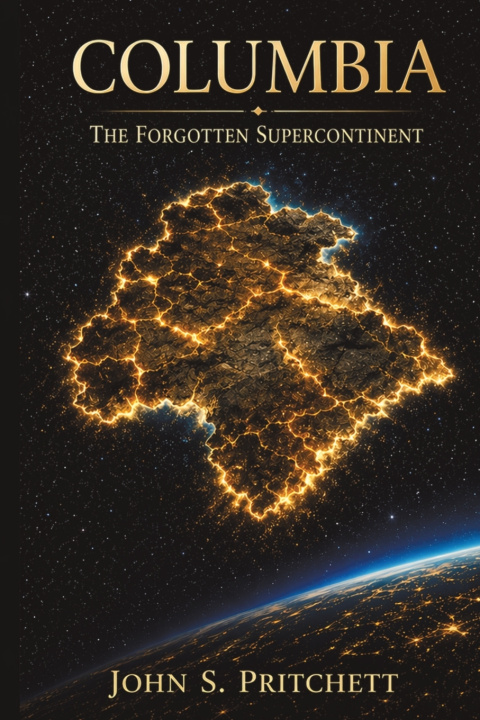
Nearly two billion years ago, pieces of Earth's oldest crust came together to form one of the planet's earliest great supercontinents. Its name was Columbia-and its remains are still beneath our feet.
Columbia: The Forgotten Supercontinent explores a vanished world assembled long before Pangaea, when ancient continental fragments known as cratons collided, mountain ranges rose across thousands of miles, and a hotter, more active Earth began building the deep foundations of the continents we recognize today.
John S. Pritchett guides readers through the geological evidence that allows scientists to reconstruct a landmass no human could ever have seen. Matching rock ages, aligned mountain belts, ancient suture zones, magnetic signatures, mineral systems, and the deep roots of continents all point toward a time when regions now scattered across North America, South America, Africa, Europe, Asia, and Australia were once connected.
Columbia has disappeared from the map, but it survives as structure, chemistry, and geological memory.
The book explains how ancient oceans closed before continents collided, how the crust folded and thickened to form mountain systems, and how those mountains eventually eroded until almost nothing remained at the surface. Beneath them, however, their roots endured-preserving metamorphic belts, fractures, mineral deposits, and the scars of continental assembly.
Those ancient processes also created extraordinary material legacies. Diamonds formed deep beneath stable cratons and were later carried upward by violent volcanic eruptions. Gold, copper, nickel, iron, uranium, and other resources became concentrated as heat, magma, pressure, and mineral-rich fluids moved through the crust.
Many of the materials on which modern civilization depends were shaped by events that occurred during Earth's deep past.
The book examines:
- How cratons became the durable foundations of continents
- What Earth was like when its mantle was hotter and its atmosphere contained little oxygen
- How ocean closure and continental collision built Columbia
- Why immense ancient mountain ranges vanished
- How mantle heat drives tectonic motion and volcanism
- Where diamonds form and how they reach the surface
- How collisions concentrate gold, copper, nickel, iron, and other metals
- How geologists compare rocks across continents to reconstruct lost worlds
- Why Columbia eventually broke apart
- Where future discoveries may refine its still-incomplete map
- How Columbia fits into the continuing supercontinent cycle
Accessible, richly illustrated, and grounded in geology, Columbia: The Forgotten Supercontinent reveals how scientists read Earth's history through fragments that have survived billions of years of collision, erosion, burial, and continental drift.
It is a story not only of a lost landmass, but of how the planet preserves its past and carries it forward.
The surface of Earth is temporary. Beneath it, the record of vanished worlds remains-written in stone and waiting to be read.


Informationen zum Buch
Englisch

Verschenken Sie dieses Buch noch heute
Es ist ganz einfach
1 Legen Sie das Buch in Ihren Warenkorb und wählen Sie den Versand als Geschenk 2 Wir schicken Ihnen umgehend einen Gutschein 3 Das Buch wird an die Adresse des beschenkten Empfängers geliefertHallo! Ich bin Libroamiko, dein Buchberater.
Wie kann ich dir helfen?