
 Kontakt
 Wie einkaufen

Versand
Kaufberater
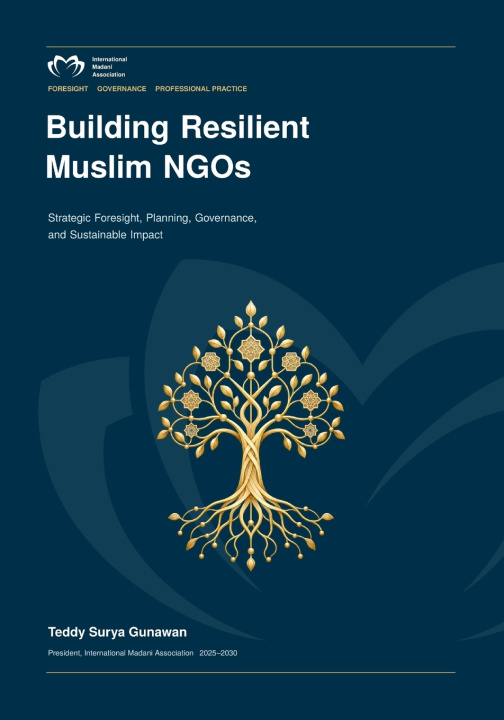
Building Resilient Muslim NGOs
Strategic Foresight, Planning, Governance, and Sustainable Impact
 Englisch
 56 b
 Demnächst
 Neu
Bis zu 30 Tage Rückgaberecht

When change is the only constant, how can Muslim NGOs endure and thrive?
Muslim charities, professional associations, schools, community organisations and international networks are often built on deep commitment and generous volunteers. Many still depend on one founder, keep informal finances, plan year by year, and grow across borders faster than their governance can follow. Building Resilient Muslim NGOs gives boards, officers and emerging leaders a practical way to prepare for the future without losing sight of why the organisation exists.
The book links Islamic stewardship (amanah), consultation (shura), justice and excellence with established management research on strategy, foresight, governance, finance, risk, measurement and learning. Islamic principles are used with care: primary sources, scholarship, management theory and the author's own proposals are kept clearly apart.
Inside you will find:
- Mission, amanah and organisational purpose, and what resilience really means for a volunteer-led organisation
- Environmental scanning, internal analysis, and SWOT and TOWS used critically rather than as a box-filling exercise
- Strategic foresight and scenario planning step by step: focal questions, drivers, critical uncertainties, scenario narratives, stress tests, robust strategies and early-warning indicators
- Turning strategy into priorities, objectives, KPIs, initiatives, budgets and owners
- Governance for Muslim NGOs: board and management roles, shura and clear authority, founder dependence, succession, and headquarters, national and affiliate relationships
- Financial sustainability, reserves, internal controls, risk management, business continuity and partnerships
- Digital transformation and AI, education and professional development, and publishing
- Monitoring, evaluation, learning and impact measurement
- An integrated framework proposed in this book (Amanah, Understand, Anticipate, Choose, Plan, Execute, Measure, Learn, Adapt) and a complete five-year worked example
- A practice handbook on meetings and minutes, budgets and audits, training and fair progression, tarbiyah and study circles, youth development, projects and events, member services, AGMs, elections and officer handover
- Worksheets, templates and checklists in the appendices, from a PESTLE template and TOWS matrix to a risk register, governance self-assessment and five-year planning checklist
A running case
The International Madani Association (IMA) is used as the running case. Its current arrangements are stated as they stand at the time of writing, and proposals are labelled as proposals. The methods serve Muslim NGOs of many kinds in many countries.
Who this book is for
Founders, board and trustee members, presidents, secretaries and treasurers, executive directors, planning committees, chapter and country leaders, program managers, volunteers and students of nonprofit management. The book is written in plain language, defines technical terms on first use, and keeps full references for readers who want to go further. Each chapter ends with key takeaways and discussion questions for boards and teams.
About the author
Teddy Surya Gunawan is President of the International Madani Association (IMA) for the 2025-2030 term and a Professor of Electrical and Computer Engineering at the International Islamic University Malaysia (IIUM). He was President of the Indonesian Muslim Association Singapura (IMAS) from 2000 to 2002, chaired the IEEE Instrumentation and Measurement Society Malaysia, and served IIUM's Faculty of Engineering as Head of Department and Head of Programme Accreditation and Quality Assurance. He holds a PhD from the University of New South Wales, Australia (2007), and a Postgraduate Diploma in Islamic Studies from IIUM (2022).


Informationen zum Buch
Englisch

Verschenken Sie dieses Buch noch heute
Es ist ganz einfach
1 Legen Sie das Buch in Ihren Warenkorb und wählen Sie den Versand als Geschenk 2 Wir schicken Ihnen umgehend einen Gutschein 3 Das Buch wird an die Adresse des beschenkten Empfängers geliefertHallo! Ich bin Libroamiko, dein Buchberater.
Wie kann ich dir helfen?