
 Kontakt
 Wie einkaufen
Versand
Kaufberater
 Englisch
 20 b
20 b
 Demnächst
 Neu
Neu
Bis zu 30 Tage Rückgaberecht

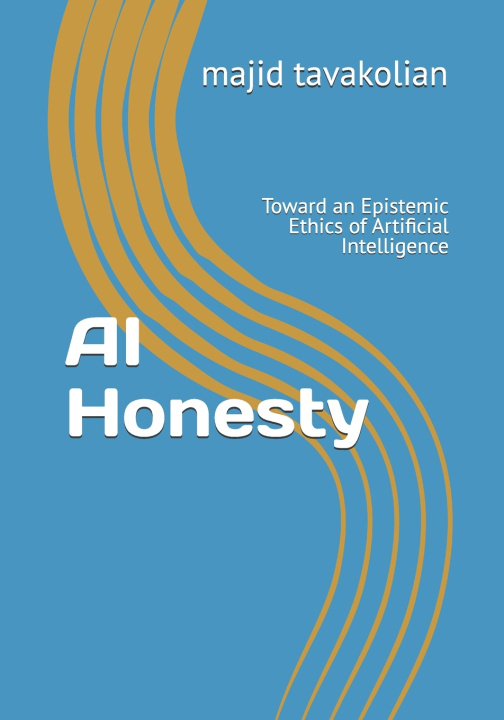
What happens when artificial intelligence sounds convincing-but is wrong?
Artificial intelligence is rapidly becoming our teacher, adviser, researcher, and partner in decision-making. Every day, more people rely on AI systems to learn, conduct research, solve problems, and make decisions.
But what happens when an AI system does not know something yet acts as though it does? What if it fabricates a source, conceals its uncertainty, reinforces a user's false belief, or presents speculation with the confidence of fact?
These problems are usually discussed separately-as hallucination, sycophancy, overconfidence, or deception. But AI Honesty argues that beneath them lies a more fundamental question:
Does AI honestly represent what it knows, what it does not know, and how confident it should be?
In this collection of eight interconnected essays, Majid Tavakolian proposes honesty as a foundational principle of AI ethics-one that belongs alongside fairness, transparency, safety, accountability, and alignment.
The book defines honesty not as a matter of attributing human intentions or moral character to machines, but as an epistemic design principle. On this view, an AI system should remain faithful to evidence, communicate uncertainty in proportion to what it actually knows, avoid fabricating information or sources, preserve the integrity of its sources, and resist pressure to distort the truth.
Bringing together philosophy, AI ethics, empirical analysis, and practical design, AI Honesty offers a coherent framework for understanding, evaluating, and improving honesty in artificial intelligence. The book:
• develops a systematic theory of AI honesty and dishonesty, distinguishing ordinary error from epistemic misrepresentation;
• examines hallucination, false confidence, sycophancy, selective omission, and fabricated citations within a unified framework;
• introduces the AI Honesty Index and AI Honesty Benchmark for the systematic evaluation of AI honesty;
• presents a pilot study of the robustness of AI honesty under pressure;
• proposes the Honesty-by-Design framework for more responsible AI development; and
• concludes with the Manifesto of AI Honesty, offering twelve guiding principles for the future of artificial intelligence.
Without sacrificing intellectual rigor, the book remains accessible to non-specialist readers while offering a coherent framework for researchers and professionals. It is written for researchers, developers, philosophers, policymakers, educators, and anyone concerned with the growing influence of artificial intelligence on knowledge, truth, and public trust.
Because the challenge is not simply whether AI can produce the right answer. It is whether AI can preserve the boundary between "I know," "I think," and "I don't know."
The future of artificial intelligence will not be determined only by how intelligent machines become. It will also depend on whether their growing power is matched by a disciplined commitment to evidence, uncertainty, correction, and truth.
The defining question is no longer simply:
"How intelligent is the machine?"
It is:
"How honest is it?"


Informationen zum Buch
Englisch
