
 Kontakt
 Wie einkaufen
Versand
Kaufberater
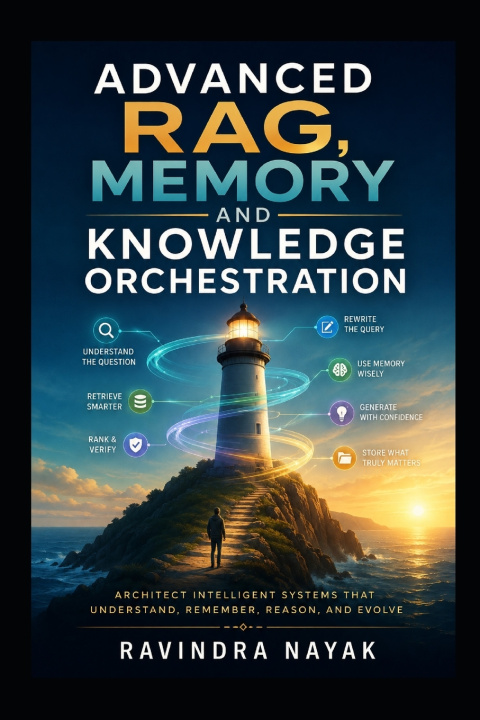
Advanced RAG, Memory and Knowledge Orchestration
 Englisch
 35 b
35 b
 Demnächst
 Neu
Neu
Bis zu 30 Tage Rückgaberecht

What happens after a question is asked-but before a trustworthy answer appears?
For many readers, advanced RAG, vector search, memory systems, reranking, provenance, agentic retrieval, and evaluation arrive as a wall of technical language. This book takes the opposite path. It begins with the human problem.
You have a question. The information you need may be scattered across documents, memory, vector databases, structured records, tools, and live sources. Some of it is current. Some is stale. Some is authoritative. Some is incomplete. Some sources agree; others conflict. The challenge is not simply to retrieve more information. It is to decide what deserves to influence the answer.
Advanced RAG, Memory and Knowledge Orchestration builds that understanding step by step for readers who do not want to treat modern AI systems as magic. Starting from first principles, it explains how a system can understand a question, rewrite or decompose it, search different sources, rank evidence, verify claims, manage memory, handle changing knowledge, and decide when to continue, stop, escalate, or admit uncertainty.
The journey moves from search to evidence, then into disciplined memory, layered and hybrid retrieval, query rewriting, reranking, context packing, evidence sufficiency, provenance, contradiction handling, confidence, time-aware and version-aware knowledge, memory refresh, knowledge graphs, agentic RAG, fallback strategies, evaluation, observability, drift, and trust governance.
Mathematics is introduced only when it helps make a decision visible. Weighted scores, thresholds, precision, recall, information gain, budgets, and trade-offs are explained as thinking tools rather than barriers. Dialogues, worked examples, mind maps, and practical exercises keep the ideas grounded in real human questions.
The final Value Edition turns the book into a learning laboratory. Instead of asking the reader to reread passively, it uses reconstruction, chunking, problem decomposition, blank-page rebuilding, diagnostic questions, and brain-training exercises to help the architecture become usable knowledge.
By the end, the reader should be able to look at a modern knowledge architecture and ask clear questions: What are we trying to know? Where should we search? Why did this evidence win? What can be trusted? What should be remembered? What has changed? When is the evidence sufficient? When should the system ask for help?
This is not a platform-specific coding manual and it does not promise a universal architecture. It is a practical first-principles guide to understanding how retrieval-augmented generation, memory, evidence, verification, and orchestration can work together as one controlled knowledge system.


Informationen zum Buch
Englisch
Kategorie

Verschenken Sie dieses Buch noch heute
Es ist ganz einfach
1 Legen Sie das Buch in Ihren Warenkorb und wählen Sie den Versand als Geschenk 2 Wir schicken Ihnen umgehend einen Gutschein 3 Das Buch wird an die Adresse des beschenkten Empfängers geliefertHallo! Ich bin Libroamiko, dein Buchberater.
Wie kann ich dir helfen?