
 Kontakt
 Wie einkaufen
Versand
Kaufberater
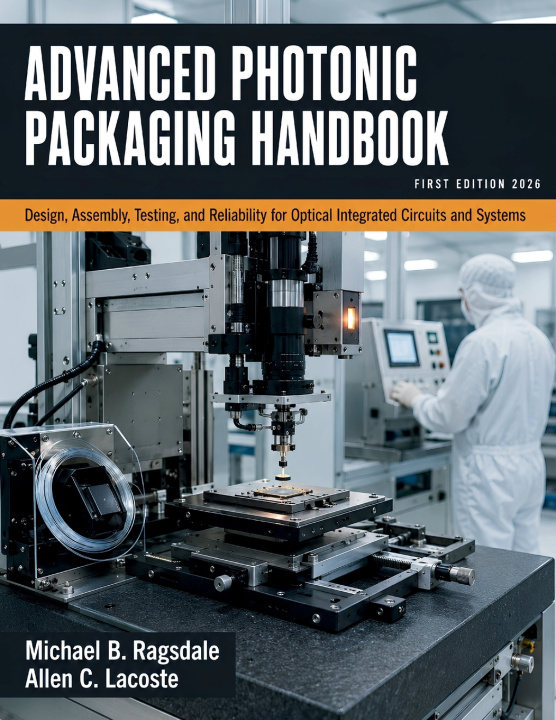
Advanced Photonic Packaging Handbook
Design, Assembly, Testing, and Reliability for Optical Integrated Circuits and Systems
 Englisch
 224 b
224 b
 Neu
Neu
Bis zu 30 Tage Rückgaberecht

Photonic packaging is one of the fastest-moving, most consequential disciplines in modern optical engineering, and a photonic integrated circuit can be flawless on the wafer and still fail the system it was built for, because the package around it, not the chip itself, is what now decides whether that performance survives contact with the real world.
Anyone turning a photonic chip into a deployable product runs into the same wall almost immediately: fiber-to-chip coupling loss, sub-micron alignment tolerance, thermal drift, hermeticity, and electrical interconnect all have to be solved together, and the knowledge needed to solve them is scattered across separate traditions. Optical coupling physics lives in one body of literature. Flip-chip and hybrid bonding practice comes from the electronic-packaging world. Qualification and reliability testing draw on more than one industry's tradition, and rarely appear side by side. Meanwhile, bandwidth demand from data-center and artificial-intelligence interconnect keeps outpacing what discrete, pluggable optics can economically deliver, which means the package itself is now the constraint most system designs run into first.
This handbook was built to close that gap in a single, complete volume. Across eighteen chapters organized into four connected movements, platform and system architecture, physical assembly, cross-cutting verification disciplines, and qualification, diagnosis, and applied practice, it follows a real engineering decision path rather than a loose topic survey, so a reader can work through the whole pipeline once or open directly to the chapter that answers today's specific question.
Inside, you will:
- Work through fiber-to-chip coupling loss and alignment-tolerance budgets step by step, using worked examples that track every variable and unit to a final numerical answer, then practice the same calculations in chapter-end problems.
- Compare the coupling techniques, integration architectures, and assembly processes available at each stage, so a platform, coupling method, or bonding process can be chosen and justified on quantified grounds rather than convention.
- Understand what co-packaged optics, photonic interposers, and multi-dimensional integration each solve, and when each is the right call, through dedicated design exercises on major architecture decisions.
- Follow the assembly disciplines that turn a chosen architecture into a manufacturable part, including die attach, wire bonding, flip-chip and hybrid bonding, adhesives, and hermetic enclosure design.
- Apply the cross-cutting disciplines every photonic package must satisfy at once: optical alignment automation, thermal and mechanical stability, signal integrity, and metrology and process control.
- Build a reliability qualification and failure-analysis plan drawing on more than one industry's testing tradition, using the glossary, symbols list, and standards quick-reference appendix as fast lookup tools.
- See the same framework applied to data-center interconnect, sensing systems, biomedical photonics, aerospace and automotive systems, and quantum and cryogenic photonics.
This book is written for senior undergraduate and graduate students; photonic, optoelectronic, semiconductor, and process engineers; mechanical, electrical, materials, thermal, test, and reliability engineers moving into photonic product development; chip designers; manufacturing, assembly, quality, and process-control engineers; product-development engineers across data-center, telecom, sensing, biomedical, and quantum domains; technical managers; and researchers.
Get your copy and start working the fiber-to-chip coupling, architecture, assembly, and qualification decisions this field actually requires, in one reference built to be read start to finish or opened directly to the chapter a project demands.


Informationen zum Buch
Englisch

Verschenken Sie dieses Buch noch heute
Es ist ganz einfach
1 Legen Sie das Buch in Ihren Warenkorb und wählen Sie den Versand als Geschenk 2 Wir schicken Ihnen umgehend einen Gutschein 3 Das Buch wird an die Adresse des beschenkten Empfängers geliefertHallo! Ich bin Libroamiko, dein Buchberater.
Wie kann ich dir helfen?